
ARFS - regression#
ARFS can be used for classification (binary or multi-class) and for regression. You just have to specify the right loss function.
[ ]:
# from IPython.core.display import display, HTML
# display(HTML("<style>.container { width:95% !important; }</style>"))
import numpy as np
import matplotlib.pyplot as plt
import gc
from sklearn.pipeline import Pipeline
from sklearn.base import clone
from sklearn.ensemble import RandomForestRegressor
from lightgbm import LGBMRegressor
from xgboost import XGBRegressor
from catboost import CatBoostRegressor

import arfs
import arfs.feature_selection.allrelevant as arfsgroot
from arfs.feature_selection import (
    MissingValueThreshold,
    UniqueValuesThreshold,
    CollinearityThreshold,
    make_fs_summary,
)
from arfs.utils import LightForestRegressor
from arfs.benchmark import highlight_tick, compare_varimp
from arfs.utils import load_data

plt.style.use("fivethirtyeight")
rng = np.random.RandomState(seed=42)

# import warnings
# warnings.filterwarnings('ignore')
[2]:
print(f"Run with ARFS {arfs.__version__}")
Run with ARFS 3.0.0
[3]:
%matplotlib inline
[4]:
gc.enable()
gc.collect()
[4]:
4
Simple Usage#
In the following examples, I’ll use a classical data set to which I added random predictors (numerical and categorical). An All Relveant FS methods should discard them. In the unit tests, you’ll find examples using artifical data with genuine (correlated and non-linear) predictors and with some random/noise columns.
Leshy (Boruta evolution)#
[5]:
boston = load_data(name="Boston")
X, y = boston.data, boston.target
[6]:
X.dtypes
[6]:
CRIM             float64
ZN               float64
INDUS            float64
CHAS            category
NOX              float64
RM               float64
AGE              float64
DIS              float64
RAD             category
TAX              float64
PTRATIO          float64
B                float64
LSTAT            float64
random_num1      float64
random_num2        int32
random_cat      category
random_cat_2    category
genuine_num      float64
dtype: object
[7]:
X.head()
[7]:
| CRIM | ZN | INDUS | CHAS | NOX | RM | AGE | DIS | RAD | TAX | PTRATIO | B | LSTAT | random_num1 | random_num2 | random_cat | random_cat_2 | genuine_num | |
|---|---|---|---|---|---|---|---|---|---|---|---|---|---|---|---|---|---|---|
| 0 | 0.00632 | 18.0 | 2.31 | 0.0 | 0.538 | 6.575 | 65.2 | 4.0900 | 1.0 | 296.0 | 15.3 | 396.90 | 4.98 | 0.496714 | 0 | cat_3517 | Platist | 7.080332 |
| 1 | 0.02731 | 0.0 | 7.07 | 0.0 | 0.469 | 6.421 | 78.9 | 4.9671 | 2.0 | 242.0 | 17.8 | 396.90 | 9.14 | -0.138264 | 0 | cat_2397 | MarkZ | 5.245384 |
| 2 | 0.02729 | 0.0 | 7.07 | 0.0 | 0.469 | 7.185 | 61.1 | 4.9671 | 2.0 | 242.0 | 17.8 | 392.83 | 4.03 | 0.647689 | 0 | cat_3735 | Dracula | 6.375795 |
| 3 | 0.03237 | 0.0 | 2.18 | 0.0 | 0.458 | 6.998 | 45.8 | 6.0622 | 3.0 | 222.0 | 18.7 | 394.63 | 2.94 | 1.523030 | 0 | cat_2870 | Bejita | 6.725118 |
| 4 | 0.06905 | 0.0 | 2.18 | 0.0 | 0.458 | 7.147 | 54.2 | 6.0622 | 3.0 | 222.0 | 18.7 | 396.90 | 5.33 | -0.234153 | 4 | cat_1160 | Variance | 7.867781 |
[8]:
# Let's use lightgbm as booster, see below for using more models
model = LGBMRegressor(random_state=42, verbose=-1)
Native (impurity/Gini) feature importance, known to be biased.
[9]:
%%time
# Leshy
feat_selector = arfsgroot.Leshy(
    model, n_estimators=20, verbose=1, max_iter=10, random_state=42, importance="native"
)
feat_selector.fit(X, y, sample_weight=None)
print(f"The selected features: {feat_selector.get_feature_names_out()}")
print(f"The agnostic ranking: {feat_selector.ranking_}")
print(f"The naive ranking: {feat_selector.ranking_absolutes_}")
fig = feat_selector.plot_importance(n_feat_per_inch=5)

# highlight synthetic random variable
fig = highlight_tick(figure=fig, str_match="random")
fig = highlight_tick(figure=fig, str_match="genuine", color="green")
plt.show()
Leshy finished running using native var. imp.

Iteration:      1 / 10
Confirmed:      10
Tentative:      2
Rejected:       6
All relevant predictors selected in 00:00:00.87
The selected features: ['CRIM' 'NOX' 'RM' 'AGE' 'DIS' 'TAX' 'PTRATIO' 'B' 'LSTAT' 'genuine_num']
The agnostic ranking: [1 3 2 6 1 1 1 1 6 1 1 1 1 2 4 6 6 1]
The naive ranking: ['LSTAT', 'RM', 'genuine_num', 'CRIM', 'NOX', 'DIS', 'PTRATIO', 'AGE', 'TAX', 'B', 'INDUS', 'random_num1', 'ZN', 'random_num2', 'CHAS', 'RAD', 'random_cat', 'random_cat_2']

CPU times: user 1.81 s, sys: 233 ms, total: 2.04 s
Wall time: 1.61 s
SHAP importance
[10]:
%%time

model = clone(model)

# Leshy
feat_selector = arfsgroot.Leshy(
    model, n_estimators=20, verbose=1, max_iter=10, random_state=42, importance="shap"
)
feat_selector.fit(X, y, sample_weight=None)
print(f"The selected features: {feat_selector.get_feature_names_out()}")
print(f"The agnostic ranking: {feat_selector.ranking_}")
print(f"The naive ranking: {feat_selector.ranking_absolutes_}")
fig = feat_selector.plot_importance(n_feat_per_inch=5)

# highlight synthetic random variable
fig = highlight_tick(figure=fig, str_match="random")
fig = highlight_tick(figure=fig, str_match="genuine", color="green")
plt.show()
Leshy finished running using shap var. imp.

Iteration:      1 / 10
Confirmed:      9
Tentative:      2
Rejected:       7
All relevant predictors selected in 00:00:01.49
The selected features: ['CRIM' 'NOX' 'RM' 'AGE' 'DIS' 'PTRATIO' 'LSTAT' 'random_num1'
 'genuine_num']
The agnostic ranking: [1 6 3 6 1 1 1 1 6 2 1 2 1 1 6 6 6 1]
The naive ranking: ['LSTAT', 'RM', 'genuine_num', 'CRIM', 'PTRATIO', 'DIS', 'AGE', 'random_num1', 'NOX', 'TAX', 'B', 'INDUS', 'random_num2', 'CHAS', 'RAD', 'ZN', 'random_cat', 'random_cat_2']

CPU times: user 2.63 s, sys: 152 ms, total: 2.78 s
Wall time: 2.29 s
SHAP importance - fasttreeshap implementation
[11]:
%%time

model = clone(model)

# Leshy
feat_selector = arfsgroot.Leshy(
    model,
    n_estimators=20,
    verbose=1,
    max_iter=10,
    random_state=42,
    importance="fastshap",
)
feat_selector.fit(X, y, sample_weight=None)
print(f"The selected features: {feat_selector.get_feature_names_out()}")
print(f"The agnostic ranking: {feat_selector.ranking_}")
print(f"The naive ranking: {feat_selector.ranking_absolutes_}")
fig = feat_selector.plot_importance(n_feat_per_inch=5)

# highlight synthetic random variable
fig = highlight_tick(figure=fig, str_match="random")
fig = highlight_tick(figure=fig, str_match="genuine", color="green")
plt.show()
/home/bsatom/Documents/arfs/src/arfs/feature_selection/allrelevant.py:325: UserWarning: fasttreeshap is not installed. Fallback to shap.
  warnings.warn("fasttreeshap is not installed. Fallback to shap.")
Leshy finished running using shap var. imp.

Iteration:      1 / 10
Confirmed:      9
Tentative:      2
Rejected:       7
All relevant predictors selected in 00:00:01.97
The selected features: ['CRIM' 'NOX' 'RM' 'AGE' 'DIS' 'PTRATIO' 'LSTAT' 'random_num1'
 'genuine_num']
The agnostic ranking: [1 6 3 6 1 1 1 1 6 2 1 2 1 1 6 6 6 1]
The naive ranking: ['LSTAT', 'RM', 'genuine_num', 'CRIM', 'PTRATIO', 'DIS', 'AGE', 'random_num1', 'NOX', 'TAX', 'B', 'INDUS', 'random_num2', 'CHAS', 'RAD', 'ZN', 'random_cat', 'random_cat_2']

CPU times: user 2.93 s, sys: 204 ms, total: 3.13 s
Wall time: 2.98 s
with permutation importance
[12]:
%%time

model = clone(model)

# Leshy
feat_selector = arfsgroot.Leshy(
    model, n_estimators=20, verbose=1, max_iter=10, random_state=42, importance="pimp"
)
feat_selector.fit(X, y, sample_weight=None)
print(f"The selected features: {feat_selector.get_feature_names_out()}")
print(f"The agnostic ranking: {feat_selector.ranking_}")
print(f"The naive ranking: {feat_selector.ranking_absolutes_}")
fig = feat_selector.plot_importance(n_feat_per_inch=5)

# highlight synthetic random variable
fig = highlight_tick(figure=fig, str_match="random")
fig = highlight_tick(figure=fig, str_match="genuine", color="green")
plt.show()
Leshy finished running using pimp var. imp.

Iteration:      1 / 10
Confirmed:      7
Tentative:      5
Rejected:       6
All relevant predictors selected in 00:00:14.25
The selected features: ['CRIM' 'NOX' 'RM' 'DIS' 'PTRATIO' 'LSTAT' 'genuine_num']
The agnostic ranking: [1 3 2 3 1 1 2 1 3 2 1 2 1 2 3 3 3 1]
The naive ranking: ['LSTAT', 'RM', 'genuine_num', 'CRIM', 'PTRATIO', 'DIS', 'NOX', 'TAX', 'B', 'AGE', 'INDUS', 'random_num1', 'random_num2', 'CHAS', 'RAD', 'ZN', 'random_cat', 'random_cat_2']

CPU times: user 5.16 s, sys: 393 ms, total: 5.55 s
Wall time: 14.9 s
BoostAGroota#
with SHAP importance
[13]:
%%time

# be sure to use the same but non-fitted estimator
model = clone(model)
# BoostAGroota
feat_selector = arfsgroot.BoostAGroota(
    estimator=model, cutoff=1, iters=10, max_rounds=10, delta=0.1, importance="shap"
)
feat_selector.fit(X, y, sample_weight=None)
print(f"The selected features: {feat_selector.get_feature_names_out()}")
print(f"The agnostic ranking: {feat_selector.ranking_}")
print(f"The naive ranking: {feat_selector.ranking_absolutes_}")
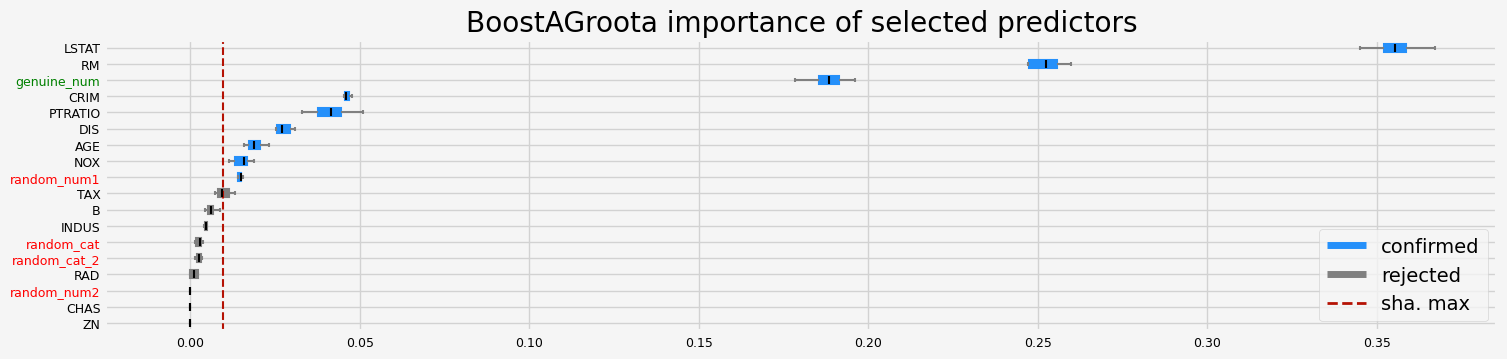
fig = feat_selector.plot_importance(n_feat_per_inch=5)

# highlight synthetic random variable
fig = highlight_tick(figure=fig, str_match="random")
fig = highlight_tick(figure=fig, str_match="genuine", color="green")
plt.show()
The selected features: ['CRIM' 'NOX' 'RM' 'AGE' 'DIS' 'PTRATIO' 'LSTAT' 'random_num1'
 'genuine_num']
The agnostic ranking: [2 1 1 1 2 2 2 2 1 1 2 1 2 2 1 1 1 2]
The naive ranking: ['LSTAT', 'RM', 'genuine_num', 'CRIM', 'PTRATIO', 'DIS', 'AGE', 'random_num1', 'NOX', 'TAX', 'B', 'INDUS', 'random_num2', 'ZN', 'CHAS', 'RAD', 'random_cat', 'random_cat_2']

CPU times: user 2.11 s, sys: 209 ms, total: 2.32 s
Wall time: 1.49 s
with SHAP importance - fasttreeshap implementation
[14]:
%%time

# be sure to use the same but non-fitted estimator
model = clone(model)
# BoostAGroota
feat_selector = arfsgroot.BoostAGroota(
    estimator=model, cutoff=1, iters=10, max_rounds=10, delta=0.1, importance="fastshap"
)
feat_selector.fit(X, y, sample_weight=None)
print(f"The selected features: {feat_selector.get_feature_names_out()}")
print(f"The agnostic ranking: {feat_selector.ranking_}")
print(f"The naive ranking: {feat_selector.ranking_absolutes_}")
fig = feat_selector.plot_importance(n_feat_per_inch=5)

# highlight synthetic random variable
fig = highlight_tick(figure=fig, str_match="random")
fig = highlight_tick(figure=fig, str_match="genuine", color="green")
plt.show()
/home/bsatom/Documents/arfs/src/arfs/feature_selection/allrelevant.py:1556: UserWarning: fasttreeshap is not installed. Fallback to shap.
  warnings.warn("fasttreeshap is not installed. Fallback to shap.")
The selected features: ['CRIM' 'NOX' 'RM' 'AGE' 'DIS' 'PTRATIO' 'LSTAT' 'random_num1'
 'genuine_num']
The agnostic ranking: [2 1 1 1 2 2 2 2 1 1 2 1 2 2 1 1 1 2]
The naive ranking: ['LSTAT', 'RM', 'genuine_num', 'CRIM', 'PTRATIO', 'DIS', 'AGE', 'NOX', 'random_num1', 'TAX', 'B', 'INDUS', 'random_cat', 'random_cat_2', 'RAD', 'random_num2', 'CHAS', 'ZN']
CPU times: user 2.99 s, sys: 218 ms, total: 3.21 s
Wall time: 2.03 s
[15]:
feat_selector.get_params()
[15]:
{'cutoff': 1,
 'delta': 0.1,
 'estimator__boosting_type': 'gbdt',
 'estimator__class_weight': None,
 'estimator__colsample_bytree': 1.0,
 'estimator__importance_type': 'split',
 'estimator__learning_rate': 0.1,
 'estimator__max_depth': -1,
 'estimator__min_child_samples': 20,
 'estimator__min_child_weight': 0.001,
 'estimator__min_split_gain': 0.0,
 'estimator__n_estimators': 20,
 'estimator__n_jobs': None,
 'estimator__num_leaves': 31,
 'estimator__objective': None,
 'estimator__random_state': 8414,
 'estimator__reg_alpha': 0.0,
 'estimator__reg_lambda': 0.0,
 'estimator__subsample': 1.0,
 'estimator__subsample_for_bin': 200000,
 'estimator__subsample_freq': 0,
 'estimator__verbose': -1,
 'estimator': LGBMRegressor(n_estimators=20, random_state=8414, verbose=-1),
 'importance': 'shap',
 'iters': 10,
 'max_rounds': 10,
 'silent': True}
GrootCV#
[16]:
%%time
# GrootCV
feat_selector = arfsgroot.GrootCV(
    objective="rmse",
    cutoff=1,
    n_folds=5,
    n_iter=5,
    silent=True,
    fastshap=False,
    n_jobs=0,
)
feat_selector.fit(X, y, sample_weight=None)
print(f"The selected features: {feat_selector.get_feature_names_out()}")
print(f"The agnostic ranking: {feat_selector.ranking_}")
print(f"The naive ranking: {feat_selector.ranking_absolutes_}")
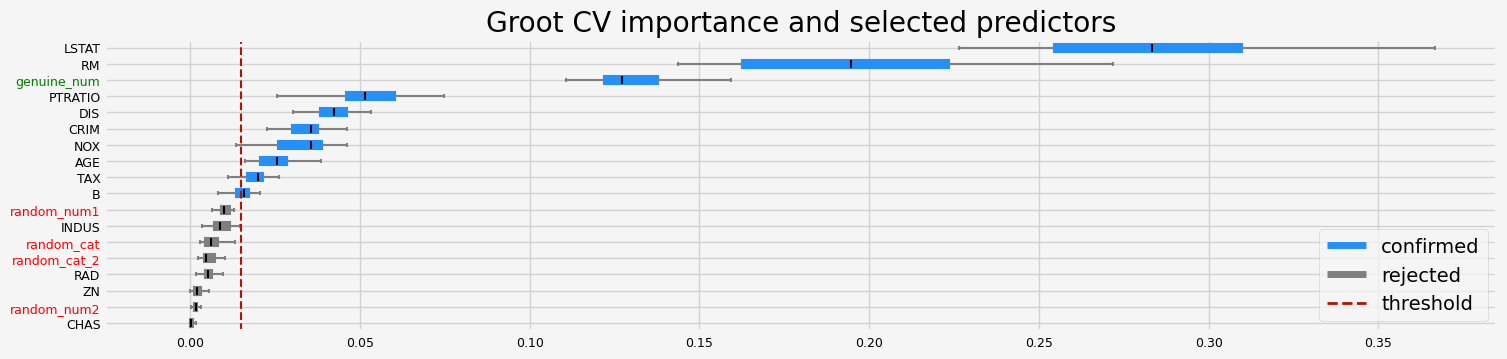
fig = feat_selector.plot_importance(n_feat_per_inch=5)

# highlight synthetic random variable
fig = highlight_tick(figure=fig, str_match="random")
fig = highlight_tick(figure=fig, str_match="genuine", color="green")
plt.show()
Training until validation scores don't improve for 20 rounds
Early stopping, best iteration is:
[218]   training's l2: 0.234061     valid_1's l2: 14.8556
Training until validation scores don't improve for 20 rounds
Early stopping, best iteration is:
[193]   training's l2: 0.184973     valid_1's l2: 9.97102
Training until validation scores don't improve for 20 rounds
Early stopping, best iteration is:
[87]    training's l2: 1.15408      valid_1's l2: 8.78114
Training until validation scores don't improve for 20 rounds
Early stopping, best iteration is:
[163]   training's l2: 0.275966     valid_1's l2: 7.70544
Training until validation scores don't improve for 20 rounds
Early stopping, best iteration is:
[103]   training's l2: 1.17445      valid_1's l2: 13.0363
Training until validation scores don't improve for 20 rounds
Early stopping, best iteration is:
[60]    training's l2: 1.84813      valid_1's l2: 11.5547
Training until validation scores don't improve for 20 rounds
Early stopping, best iteration is:
[168]   training's l2: 0.314316     valid_1's l2: 10.5172
Training until validation scores don't improve for 20 rounds
Early stopping, best iteration is:
[133]   training's l2: 0.627339     valid_1's l2: 12.1157
Training until validation scores don't improve for 20 rounds
Early stopping, best iteration is:
[139]   training's l2: 0.546039     valid_1's l2: 9.44746
Training until validation scores don't improve for 20 rounds
Early stopping, best iteration is:
[177]   training's l2: 0.216273     valid_1's l2: 7.61796
Training until validation scores don't improve for 20 rounds
Early stopping, best iteration is:
[41]    training's l2: 3.29087      valid_1's l2: 11.1179
Training until validation scores don't improve for 20 rounds
Early stopping, best iteration is:
[163]   training's l2: 0.369484     valid_1's l2: 9.48
Training until validation scores don't improve for 20 rounds
Early stopping, best iteration is:
[97]    training's l2: 0.599381     valid_1's l2: 17.8532
Training until validation scores don't improve for 20 rounds
Early stopping, best iteration is:
[80]    training's l2: 1.27388      valid_1's l2: 10.0759
Training until validation scores don't improve for 20 rounds
Early stopping, best iteration is:
[145]   training's l2: 0.46666      valid_1's l2: 8.12127
Training until validation scores don't improve for 20 rounds
Early stopping, best iteration is:
[148]   training's l2: 0.559137     valid_1's l2: 11.8552
Training until validation scores don't improve for 20 rounds
Early stopping, best iteration is:
[61]    training's l2: 1.68716      valid_1's l2: 13.6832
Training until validation scores don't improve for 20 rounds
Early stopping, best iteration is:
[43]    training's l2: 3.11061      valid_1's l2: 9.27737
Training until validation scores don't improve for 20 rounds
Early stopping, best iteration is:
[390]   training's l2: 0.0559169    valid_1's l2: 8.60581
Training until validation scores don't improve for 20 rounds
Early stopping, best iteration is:
[75]    training's l2: 1.50923      valid_1's l2: 9.87321
Training until validation scores don't improve for 20 rounds
Early stopping, best iteration is:
[96]    training's l2: 1.13672      valid_1's l2: 8.82558
Training until validation scores don't improve for 20 rounds
Early stopping, best iteration is:
[162]   training's l2: 0.390706     valid_1's l2: 5.60546
Training until validation scores don't improve for 20 rounds
Early stopping, best iteration is:
[193]   training's l2: 0.357824     valid_1's l2: 10.5909
Training until validation scores don't improve for 20 rounds
Early stopping, best iteration is:
[75]    training's l2: 1.51915      valid_1's l2: 11.3893
Training until validation scores don't improve for 20 rounds
Early stopping, best iteration is:
[170]   training's l2: 0.261767     valid_1's l2: 10.18
The selected features: ['CRIM' 'NOX' 'RM' 'AGE' 'DIS' 'TAX' 'PTRATIO' 'B' 'LSTAT' 'genuine_num']
The agnostic ranking: [2 1 1 1 2 2 2 2 1 2 2 2 2 1 1 1 1 2]
The naive ranking: ['LSTAT', 'RM', 'PTRATIO', 'DIS', 'CRIM', 'NOX', 'AGE', 'B', 'INDUS', 'ShadowVar1', 'ShadowVar14', 'ShadowVar13', 'ShadowVar12', 'ShadowVar10', 'ShadowVar11', 'RAD', 'ShadowVar15', 'CHAS']
CPU times: user 25.3 s, sys: 2.01 s, total: 27.3 s
Wall time: 12.9 s
enabling fasttreeshap
[17]:
%%time
# GrootCV
feat_selector = arfsgroot.GrootCV(
    objective="rmse",
    cutoff=1,
    n_folds=5,
    n_iter=5,
    silent=True,
    fastshap=True,
    n_jobs=0,
)
feat_selector.fit(X, y, sample_weight=None)
print(f"The selected features: {feat_selector.get_feature_names_out()}")
print(f"The agnostic ranking: {feat_selector.ranking_}")
print(f"The naive ranking: {feat_selector.ranking_absolutes_}")
fig = feat_selector.plot_importance(n_feat_per_inch=5)

# highlight synthetic random variable
fig = highlight_tick(figure=fig, str_match="random")
fig = highlight_tick(figure=fig, str_match="genuine", color="green")
plt.show()
Training until validation scores don't improve for 20 rounds
Early stopping, best iteration is:
[342]   training's l2: 0.0867896    valid_1's l2: 13.0855
---------------------------------------------------------------------------
ModuleNotFoundError                       Traceback (most recent call last)
File ~/Documents/arfs/src/arfs/feature_selection/allrelevant.py:2546, in _train_lgb_model(X_train, y_train, weight_train, X_val, y_val, weight_val, category_cols, early_stopping_rounds, fastshap, **params)
   2545 if fastshap:
-> 2546     from fasttreeshap import TreeExplainer
   2547     explainer = TreeExplainer(bst, algorithm="v1")

ModuleNotFoundError: No module named 'fasttreeshap'

During handling of the above exception, another exception occurred:

RuntimeError                              Traceback (most recent call last)
File <timed exec>:11

File ~/Documents/arfs/src/arfs/feature_selection/allrelevant.py:2063, in GrootCV.fit(self, X, y, sample_weight)
   2060 # internal encoding (ordinal encoding)
   2061 X, obj_feat, cat_idx = get_pandas_cat_codes(X)
-> 2063 self.selected_features_, self.cv_df, self.sha_cutoff = _reduce_vars_lgb_cv(
   2064     X,
   2065     y,
   2066     objective=self.objective,
   2067     cutoff=self.cutoff,
   2068     n_folds=self.n_folds,
   2069     folds=self.folds,
   2070     n_iter=self.n_iter,
   2071     silent=self.silent,
   2072     weight=sample_weight,
   2073     rf=self.rf,
   2074     fastshap=self.fastshap,
   2075     lgbm_params=self.lgbm_params,
   2076     n_jobs=self.n_jobs,
   2077 )
   2079 self.selected_features_ = self.selected_features_.values
   2080 self.support_ = np.asarray(
   2081     [c in self.selected_features_ for c in self.feature_names_in_]
   2082 )

File ~/Documents/arfs/src/arfs/feature_selection/allrelevant.py:2296, in _reduce_vars_lgb_cv(X, y, objective, folds, n_folds, cutoff, n_iter, silent, weight, rf, fastshap, lgbm_params, n_jobs)
   2293 new_x_tr, shadow_names = _create_shadow(X_train)
   2294 new_x_val, _ = _create_shadow(X_val)
-> 2296 bst, shap_matrix, bst.best_iteration = _train_lgb_model(
   2297     new_x_tr,
   2298     y_train,
   2299     weight_tr,
   2300     new_x_val,
   2301     y_val,
   2302     weight_val,
   2303     category_cols=category_cols,
   2304     early_stopping_rounds=20,
   2305     fastshap=fastshap,
   2306     **params,
   2307 )
   2309 importance = _compute_importance(
   2310     new_x_tr, shap_matrix, params, objective, fastshap
   2311 )
   2312 df = _merge_importance_df(
   2313     df=df,
   2314     importance=importance,
   (...)   2318     silent=silent,
   2319 )

File ~/Documents/arfs/src/arfs/feature_selection/allrelevant.py:2555, in _train_lgb_model(X_train, y_train, weight_train, X_val, y_val, weight_val, category_cols, early_stopping_rounds, fastshap, **params)
   2552     shap_matrix = explainer.shap_values(X_train)
   2554 except Exception as e:
-> 2555     raise RuntimeError(f"SHAP computation failed: {str(e)}")
   2557 return bst, shap_matrix, bst.best_iteration

RuntimeError: SHAP computation failed: No module named 'fasttreeshap'
ARFS in sklearn pipelines#
all the selectors (basic, arfs and MRmr) are sklearn compatible and follows the same architecture. Namely, they use the sklearn relevant base classes and therefore have the same methods.
[18]:
feat_selector = arfsgroot.GrootCV(
    objective="rmse", cutoff=1, n_folds=5, n_iter=5, silent=True
)

arfs_fs_pipeline = Pipeline(
    [
        ("missing", MissingValueThreshold(threshold=0.05)),
        ("unique", UniqueValuesThreshold(threshold=1)),
        ("collinearity", CollinearityThreshold(threshold=0.85)),
        ("arfs", feat_selector),
    ]
)

X_trans = arfs_fs_pipeline.fit(X=X, y=y).transform(X=X)
Training until validation scores don't improve for 20 rounds
Early stopping, best iteration is:
[1063]  training's l2: 0.000629921  valid_1's l2: 12.2328
Training until validation scores don't improve for 20 rounds
Early stopping, best iteration is:
[92]    training's l2: 0.970287     valid_1's l2: 13.5527
Training until validation scores don't improve for 20 rounds
Early stopping, best iteration is:
[62]    training's l2: 2.06957      valid_1's l2: 8.97033
Training until validation scores don't improve for 20 rounds
Early stopping, best iteration is:
[33]    training's l2: 4.08651      valid_1's l2: 9.11467
Training until validation scores don't improve for 20 rounds
Early stopping, best iteration is:
[118]   training's l2: 1.21085      valid_1's l2: 12.6812
Training until validation scores don't improve for 20 rounds
Early stopping, best iteration is:
[98]    training's l2: 0.877936     valid_1's l2: 12.0485
Training until validation scores don't improve for 20 rounds
Early stopping, best iteration is:
[101]   training's l2: 1.10388      valid_1's l2: 12.0083
Training until validation scores don't improve for 20 rounds
Early stopping, best iteration is:
[239]   training's l2: 0.125878     valid_1's l2: 12.5212
Training until validation scores don't improve for 20 rounds
Early stopping, best iteration is:
[51]    training's l2: 2.40803      valid_1's l2: 11.2343
Training until validation scores don't improve for 20 rounds
Early stopping, best iteration is:
[121]   training's l2: 0.61402      valid_1's l2: 7.55341
Training until validation scores don't improve for 20 rounds
Early stopping, best iteration is:
[43]    training's l2: 3.1848       valid_1's l2: 11.2493
Training until validation scores don't improve for 20 rounds
Early stopping, best iteration is:
[55]    training's l2: 3.1782       valid_1's l2: 11.6037
Training until validation scores don't improve for 20 rounds
Early stopping, best iteration is:
[66]    training's l2: 1.48967      valid_1's l2: 18.4945
Training until validation scores don't improve for 20 rounds
Early stopping, best iteration is:
[111]   training's l2: 0.851459     valid_1's l2: 10.4734
Training until validation scores don't improve for 20 rounds
Early stopping, best iteration is:
[59]    training's l2: 2.56738      valid_1's l2: 9.74563
Training until validation scores don't improve for 20 rounds
Early stopping, best iteration is:
[175]   training's l2: 0.557339     valid_1's l2: 13.2176
Training until validation scores don't improve for 20 rounds
Early stopping, best iteration is:
[145]   training's l2: 0.381629     valid_1's l2: 14.0676
Training until validation scores don't improve for 20 rounds
Early stopping, best iteration is:
[39]    training's l2: 3.76023      valid_1's l2: 10.0218
Training until validation scores don't improve for 20 rounds
Early stopping, best iteration is:
[179]   training's l2: 0.374699     valid_1's l2: 9.82231
Training until validation scores don't improve for 20 rounds
Early stopping, best iteration is:
[53]    training's l2: 2.11995      valid_1's l2: 9.95385
Training until validation scores don't improve for 20 rounds
Early stopping, best iteration is:
[135]   training's l2: 0.782215     valid_1's l2: 9.31299
Training until validation scores don't improve for 20 rounds
Early stopping, best iteration is:
[54]    training's l2: 2.57831      valid_1's l2: 7.38709
Training until validation scores don't improve for 20 rounds
Early stopping, best iteration is:
[215]   training's l2: 0.260512     valid_1's l2: 14.2698
Training until validation scores don't improve for 20 rounds
Early stopping, best iteration is:
[49]    training's l2: 2.93293      valid_1's l2: 12.2179
Training until validation scores don't improve for 20 rounds
Early stopping, best iteration is:
[110]   training's l2: 0.773806     valid_1's l2: 11.6498
you can access the attributes of a step as you would in any sklearn pipeline
[19]:
arfs_fs_pipeline.named_steps["collinearity"].get_feature_names_out()
[19]:
array(['CRIM', 'ZN', 'INDUS', 'CHAS', 'RM', 'AGE', 'DIS', 'RAD', 'TAX',
       'PTRATIO', 'B', 'LSTAT', 'random_num1', 'random_num2',
       'random_cat', 'random_cat_2', 'genuine_num'], dtype=object)
[20]:
fig = arfs_fs_pipeline.named_steps["arfs"].plot_importance()
# highlight synthetic random variable
fig = highlight_tick(figure=fig, str_match="random")
fig = highlight_tick(figure=fig, str_match="genuine", color="green")
plt.show()

[21]:
make_fs_summary(arfs_fs_pipeline)
/home/bsatom/Documents/arfs/src/arfs/feature_selection/summary.py:69: FutureWarning: Styler.applymap has been deprecated. Use Styler.map instead.
  .applymap(lambda x: "" if x == x else "background-color: #f57505")
[21]:
| predictor | missing | unique | collinearity | arfs | |
|---|---|---|---|---|---|
| 0 | CRIM | 1 | 1 | 1 | 1 |
| 1 | ZN | 1 | 1 | 1 | 0 |
| 2 | INDUS | 1 | 1 | 1 | 0 |
| 3 | CHAS | 1 | 1 | 1 | 0 |
| 4 | NOX | 1 | 1 | 0 | nan |
| 5 | RM | 1 | 1 | 1 | 1 |
| 6 | AGE | 1 | 1 | 1 | 1 |
| 7 | DIS | 1 | 1 | 1 | 1 |
| 8 | RAD | 1 | 1 | 1 | 0 |
| 9 | TAX | 1 | 1 | 1 | 1 |
| 10 | PTRATIO | 1 | 1 | 1 | 1 |
| 11 | B | 1 | 1 | 1 | 0 |
| 12 | LSTAT | 1 | 1 | 1 | 1 |
| 13 | random_num1 | 1 | 1 | 1 | 0 |
| 14 | random_num2 | 1 | 1 | 1 | 0 |
| 15 | random_cat | 1 | 1 | 1 | 0 |
| 16 | random_cat_2 | 1 | 1 | 1 | 0 |
| 17 | genuine_num | 1 | 1 | 1 | 1 |
Testing and comparing Leshy, GrootCV and BoostAGroota#
In the following examples, I’ll use different models which are scikit-learn compatible and then one can compare the different ARFS methods with different models and the different feature importance.
[22]:
%%time
model = clone(model)
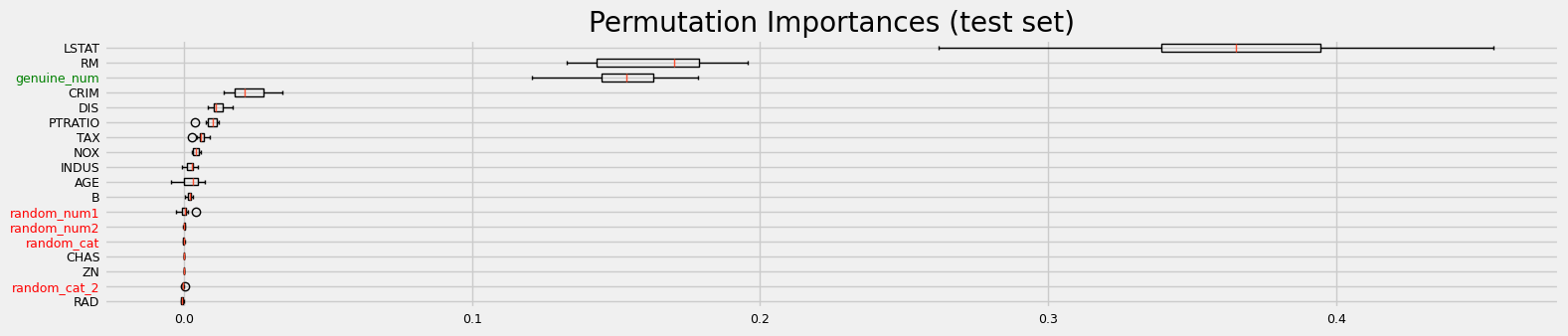
# Benchmark with scikit-learn permutation importance
print("=" * 20 + " Benchmarking using sklearn permutation importance " + "=" * 20)
fig = sklearn_pimp_bench(model, X, y, task="regression", sample_weight=None)
==================== Benchmarking using sklearn permutation importance ====================
CPU times: user 1.07 s, sys: 287 ms, total: 1.36 s
Wall time: 4.12 s
Testing Leshy#
Leshy seems to struggle with catboost, for regression and this particular data set whereas the other ARFS methods seem OK. To be investigated.
[23]:
models = [
    RandomForestRegressor(n_jobs=4, oob_score=True),
    CatBoostRegressor(random_state=42, verbose=0),
    LGBMRegressor(random_state=42, verbose=-1),
    LightForestRegressor(n_feat=X.shape[1]),
    XGBRegressor(random_state=42, verbosity=0),
]

feat_selector = arfsgroot.Leshy(
    model, n_estimators=100, verbose=1, max_iter=10, random_state=42
)

if __name__ == "__main__":
    # regression
    boston = load_data(name="Boston")
    X, y = boston.data, boston.target
    # running the ARFS methods using different models
    compare_varimp(feat_selector, models, X, y, sample_weight=None)
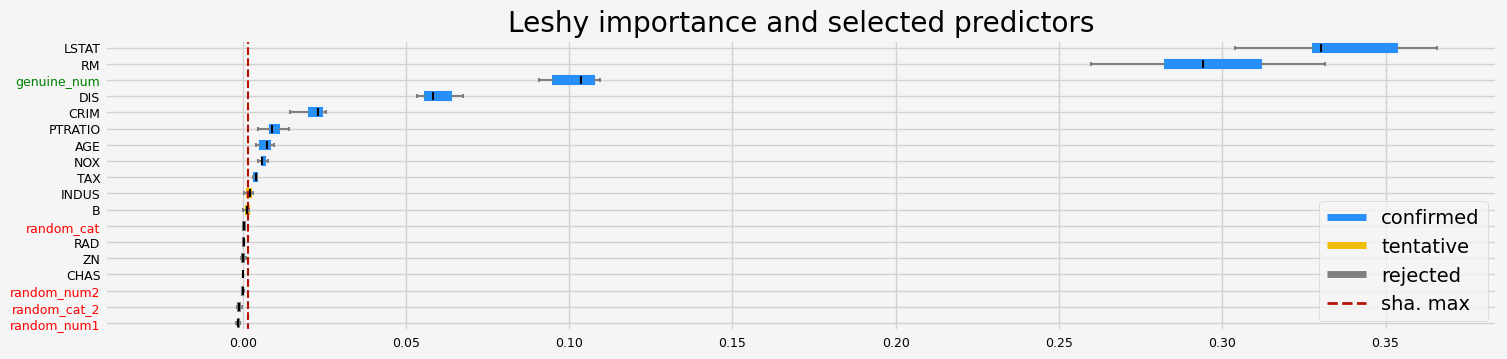
==================== Leshy - testing: RandomForestRegressor for var.imp: shap ====================
Leshy finished running using shap var. imp.

Iteration:      1 / 10
Confirmed:      11
Tentative:      1
Rejected:       6
All relevant predictors selected in 00:00:21.25
['CRIM' 'NOX' 'RM' 'AGE' 'DIS' 'TAX' 'PTRATIO' 'B' 'LSTAT' 'random_num1'
 'genuine_num']

==================== Leshy - testing: RandomForestRegressor for var.imp: pimp ====================
Leshy finished running using pimp var. imp.

Iteration:      1 / 10
Confirmed:      9
Tentative:      2
Rejected:       7
All relevant predictors selected in 00:00:56.26
['CRIM' 'NOX' 'RM' 'AGE' 'DIS' 'TAX' 'PTRATIO' 'LSTAT' 'genuine_num']
==================== Leshy - testing: RandomForestRegressor for var.imp: native ====================
Leshy finished running using native var. imp.

Iteration:      1 / 10
Confirmed:      11
Tentative:      0
Rejected:       7
All relevant predictors selected in 00:00:07.73
['CRIM' 'INDUS' 'NOX' 'RM' 'AGE' 'DIS' 'TAX' 'PTRATIO' 'B' 'LSTAT'
 'genuine_num']
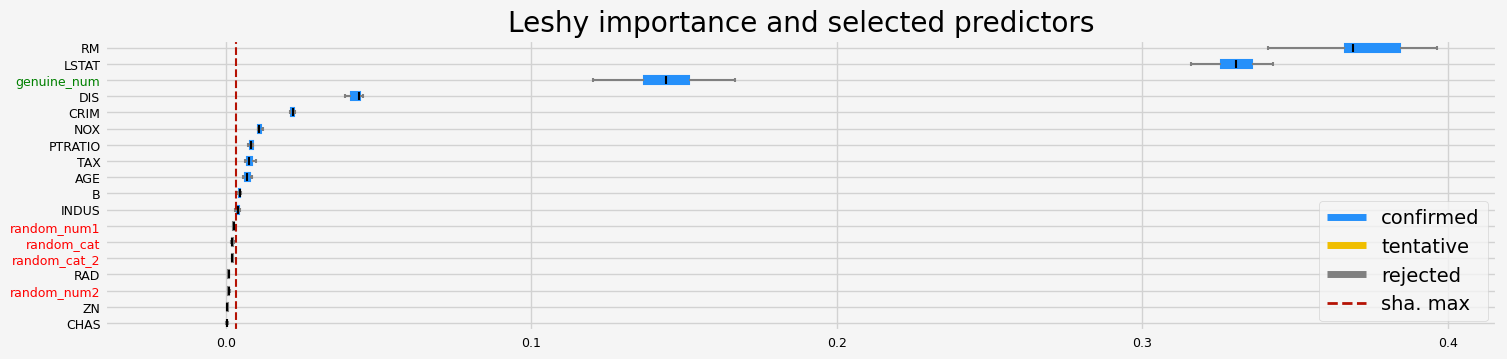
==================== Leshy - testing: CatBoostRegressor for var.imp: shap ====================
Leshy finished running using shap var. imp.

Iteration:      1 / 10
Confirmed:      7
Tentative:      5
Rejected:       6
All relevant predictors selected in 00:00:07.48
['CRIM' 'RM' 'DIS' 'PTRATIO' 'B' 'LSTAT' 'genuine_num']
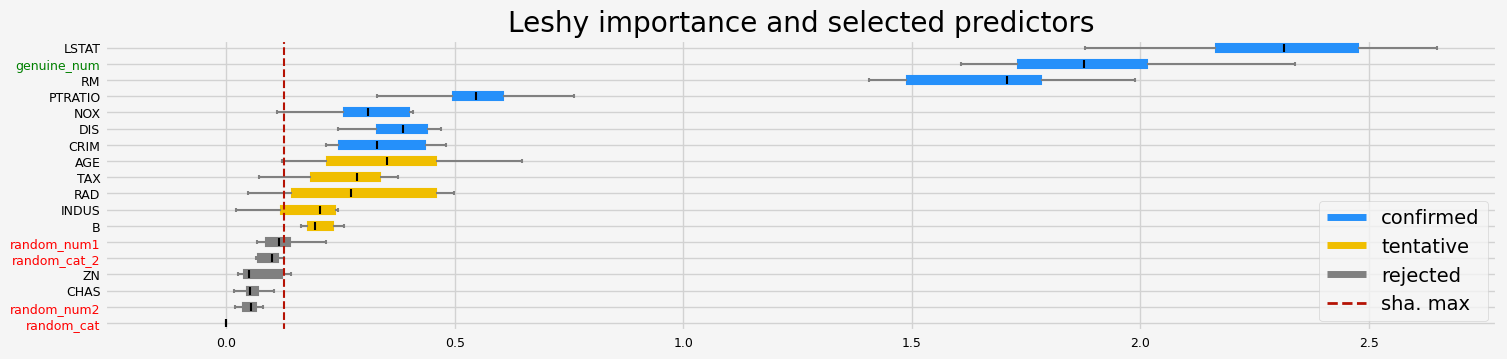
==================== Leshy - testing: CatBoostRegressor for var.imp: pimp ====================
Leshy finished running using pimp var. imp.

Iteration:      1 / 10
Confirmed:      9
Tentative:      3
Rejected:       6
All relevant predictors selected in 00:00:15.12
['NOX' 'RM' 'AGE' 'DIS' 'RAD' 'TAX' 'PTRATIO' 'LSTAT' 'genuine_num']
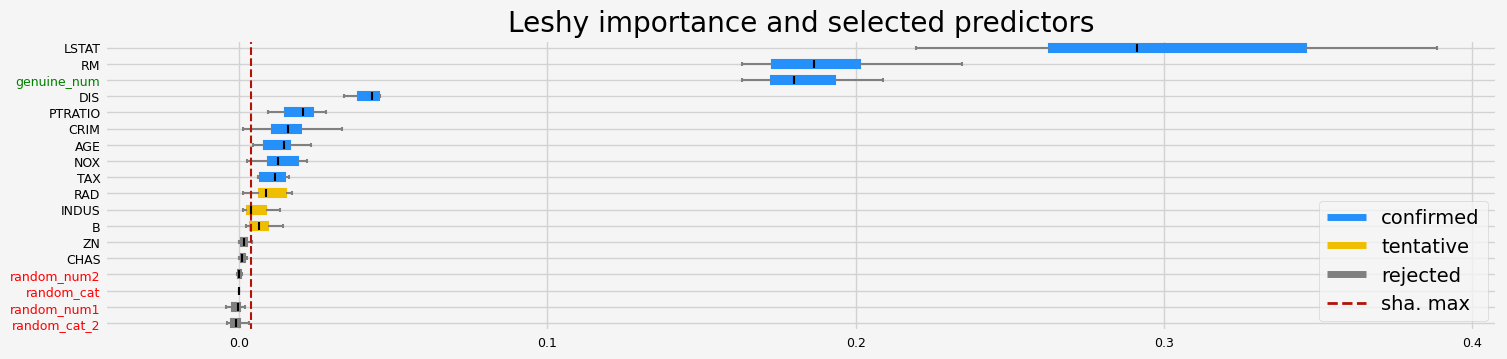
==================== Leshy - testing: CatBoostRegressor for var.imp: native ====================
Leshy finished running using native var. imp.

Iteration:      1 / 10
Confirmed:      7
Tentative:      4
Rejected:       7
All relevant predictors selected in 00:00:07.10
['NOX' 'RM' 'DIS' 'TAX' 'PTRATIO' 'LSTAT' 'genuine_num']
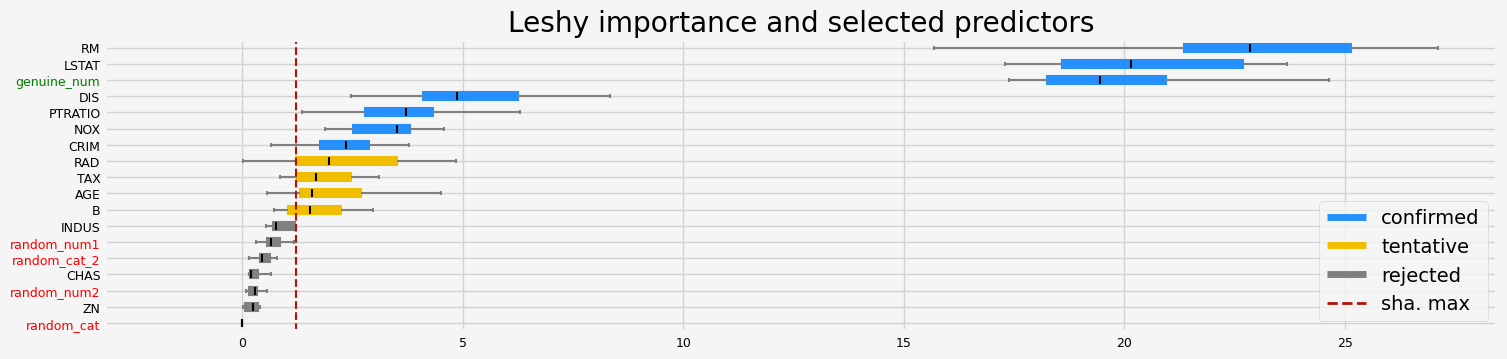
==================== Leshy - testing: LGBMRegressor for var.imp: shap ====================
Leshy finished running using shap var. imp.

Iteration:      1 / 10
Confirmed:      8
Tentative:      2
Rejected:       8
All relevant predictors selected in 00:00:02.31
['CRIM' 'NOX' 'RM' 'AGE' 'DIS' 'PTRATIO' 'LSTAT' 'genuine_num']
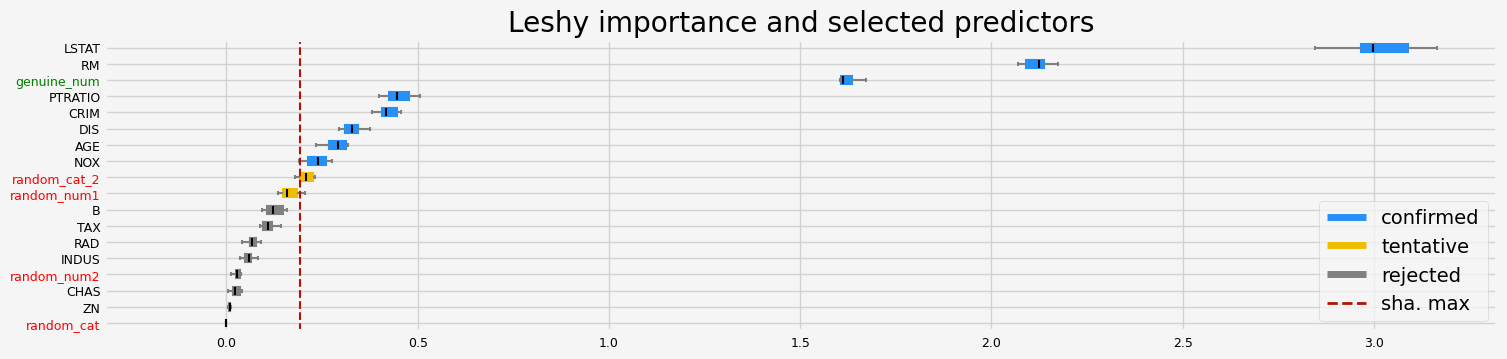
==================== Leshy - testing: LGBMRegressor for var.imp: pimp ====================
Leshy finished running using pimp var. imp.

Iteration:      1 / 10
Confirmed:      8
Tentative:      3
Rejected:       7
All relevant predictors selected in 00:00:11.82
['CRIM' 'NOX' 'RM' 'AGE' 'DIS' 'PTRATIO' 'LSTAT' 'genuine_num']
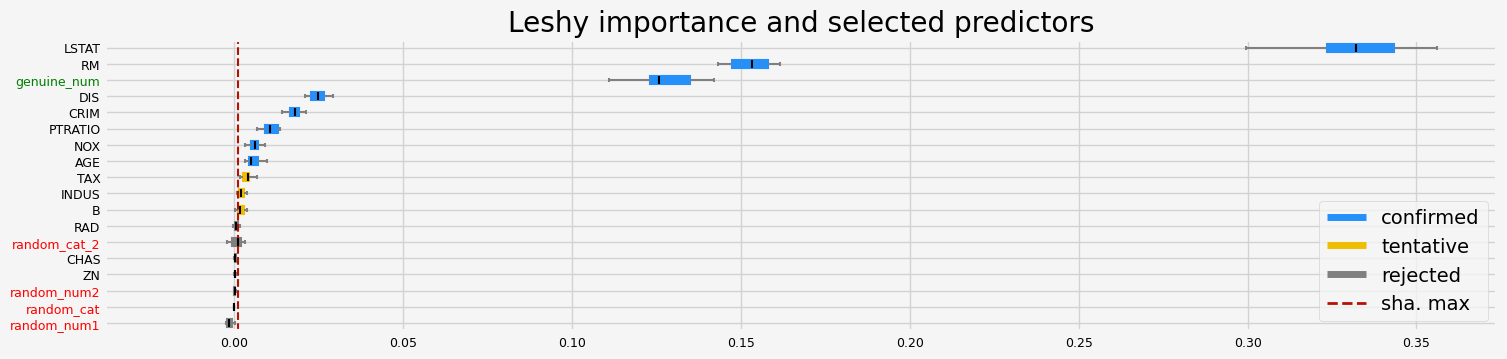
==================== Leshy - testing: LGBMRegressor for var.imp: native ====================
Leshy finished running using native var. imp.

Iteration:      1 / 10
Confirmed:      11
Tentative:      2
Rejected:       5
All relevant predictors selected in 00:00:01.73
['CRIM' 'NOX' 'RM' 'AGE' 'DIS' 'TAX' 'PTRATIO' 'B' 'LSTAT' 'random_cat_2'
 'genuine_num']
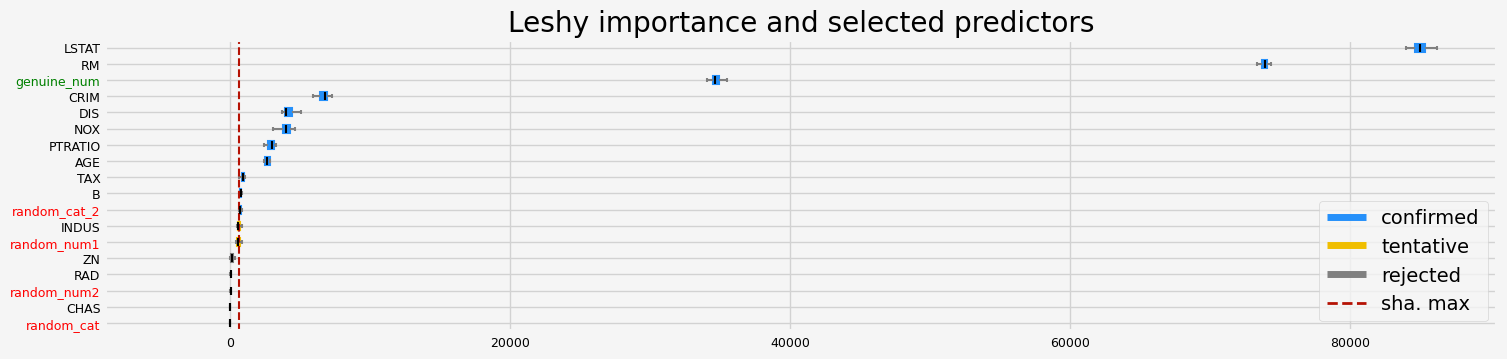
==================== Leshy - testing: LGBMRegressor for var.imp: shap ====================
Leshy finished running using shap var. imp.

Iteration:      1 / 10
Confirmed:      11
Tentative:      2
Rejected:       5
All relevant predictors selected in 00:00:01.43
['CRIM' 'INDUS' 'NOX' 'RM' 'AGE' 'DIS' 'TAX' 'PTRATIO' 'B' 'LSTAT'
 'genuine_num']
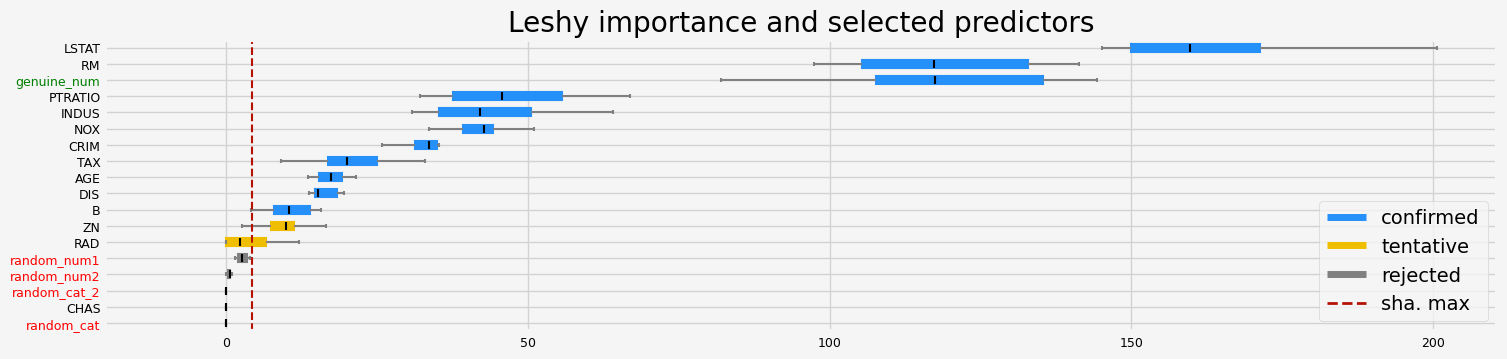
==================== Leshy - testing: LGBMRegressor for var.imp: pimp ====================
Leshy finished running using pimp var. imp.

Iteration:      1 / 10
Confirmed:      9
Tentative:      2
Rejected:       7
All relevant predictors selected in 00:00:10.03
['CRIM' 'INDUS' 'NOX' 'RM' 'DIS' 'TAX' 'PTRATIO' 'LSTAT' 'genuine_num']

==================== Leshy - testing: LGBMRegressor for var.imp: native ====================
Leshy finished running using native var. imp.

Iteration:      1 / 10
Confirmed:      12
Tentative:      1
Rejected:       5
All relevant predictors selected in 00:00:01.11
['CRIM' 'ZN' 'INDUS' 'NOX' 'RM' 'AGE' 'DIS' 'TAX' 'PTRATIO' 'B' 'LSTAT'
 'genuine_num']
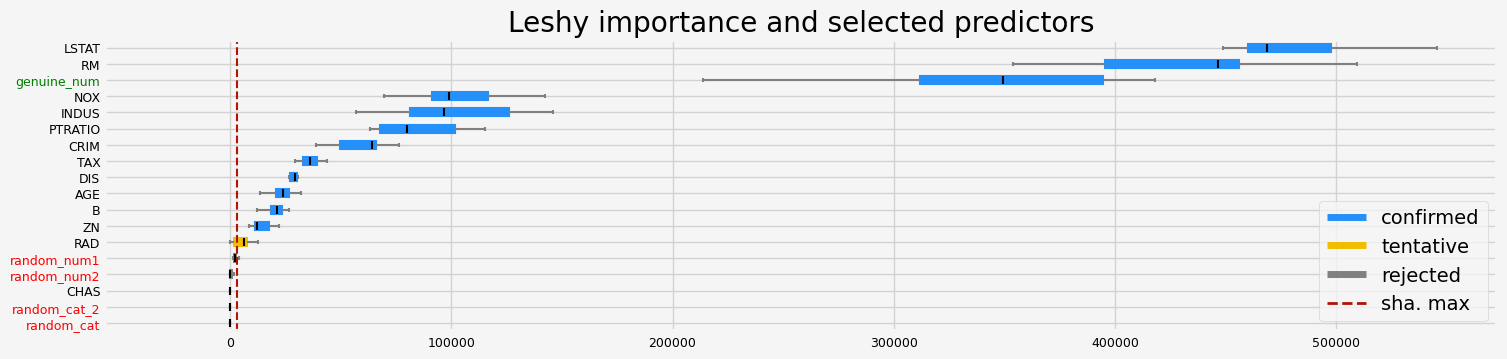
==================== Leshy - testing: XGBRegressor for var.imp: shap ====================
Leshy finished running using shap var. imp.

Iteration:      1 / 10
Confirmed:      8
Tentative:      3
Rejected:       7
All relevant predictors selected in 00:00:14.64
['CRIM' 'RM' 'AGE' 'DIS' 'PTRATIO' 'B' 'LSTAT' 'genuine_num']
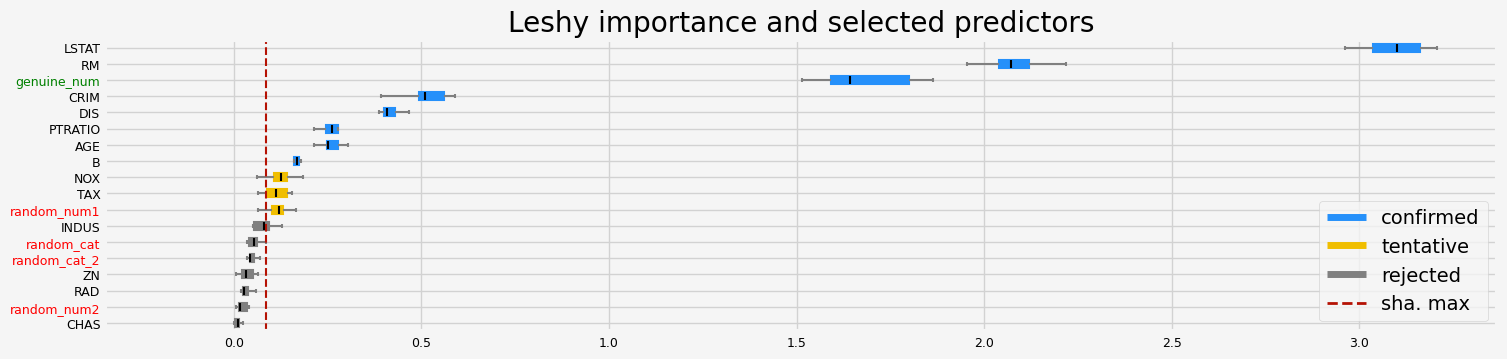
==================== Leshy - testing: XGBRegressor for var.imp: pimp ====================
Leshy finished running using pimp var. imp.

Iteration:      1 / 10
Confirmed:      6
Tentative:      5
Rejected:       7
All relevant predictors selected in 00:00:13.71
['RM' 'AGE' 'DIS' 'PTRATIO' 'LSTAT' 'genuine_num']

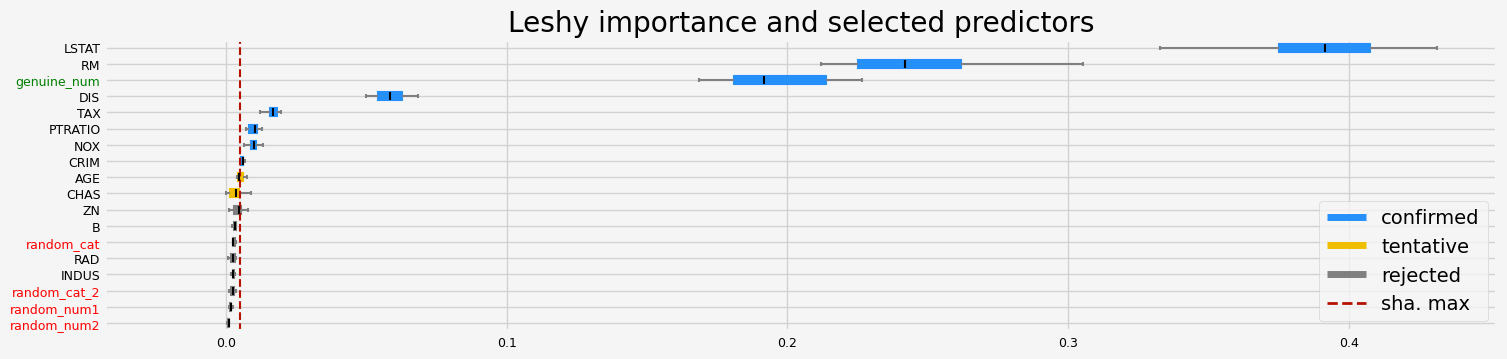
==================== Leshy - testing: XGBRegressor for var.imp: native ====================
Leshy finished running using native var. imp.

Iteration:      1 / 10
Confirmed:      8
Tentative:      2
Rejected:       8
All relevant predictors selected in 00:00:07.30
['CRIM' 'NOX' 'RM' 'DIS' 'TAX' 'PTRATIO' 'LSTAT' 'genuine_num']
[24]:
# from sklearn.datasets import make_regression
# from xgboost import XGBRegressor
# from lightgbm import LGBMRegressor
# from fasttreeshap import TreeExplainer as FastTreeExplainer

# X, y = make_regression(
#     n_samples=1000, n_features=10, n_informative=8, noise=1, random_state=8
# )
# model = XGBRegressor()  # LGBMRegressor()
# model.fit(X, y)
# explainer = FastTreeExplainer(
#     model, algorithm="auto", shortcut=False, feature_perturbation="tree_path_dependent"
# )
# shap_matrix = explainer.shap_values(X)
FastTreeShap fails when using XGBoost, I opened an issue.
[25]:
# import fasttreeshap
# import shap
# import xgboost

# print(
#     f"Using xgboost {xgboost.__version__}, shap {shap.__version__} and fasttreeshap {fasttreeshap.__version__}"
# )
Testing GrootCV#
[26]:
# Testing the changes with rnd cat. and num. predictors added to the set of genuine predictors


def testing_estimators(X, y, sample_weight=None, objective="rmse"):
    feat_selector = arfsgroot.GrootCV(
        objective=objective, cutoff=1, n_folds=5, n_iter=5, fastshap=False
    )
    feat_selector.fit(X, y, sample_weight)
    print(feat_selector.get_feature_names_out())
    fig = feat_selector.plot_importance(n_feat_per_inch=5)

    # highlight synthetic random variable
    fig = highlight_tick(figure=fig, str_match="random")
    fig = highlight_tick(figure=fig, str_match="genuine", color="green")
    plt.show()
    gc.enable()
    del feat_selector
    gc.collect()


if __name__ == "__main__":
    # regression
    boston = load_data(name="Boston")
    X, y = boston.data, boston.target
    cat_f = boston.categorical
    testing_estimators(X=X, y=y, objective="rmse")
Training until validation scores don't improve for 20 rounds
Early stopping, best iteration is:
[202]   training's l2: 0.322249     valid_1's l2: 12.0051
Training until validation scores don't improve for 20 rounds
Early stopping, best iteration is:
[318]   training's l2: 0.0621219    valid_1's l2: 11.3302
Training until validation scores don't improve for 20 rounds
Early stopping, best iteration is:
[139]   training's l2: 0.338608     valid_1's l2: 7.8433
Training until validation scores don't improve for 20 rounds
Early stopping, best iteration is:
[53]    training's l2: 2.18404      valid_1's l2: 8.30109
Training until validation scores don't improve for 20 rounds
Early stopping, best iteration is:
[151]   training's l2: 0.621778     valid_1's l2: 12.0462
Training until validation scores don't improve for 20 rounds
Early stopping, best iteration is:
[183]   training's l2: 0.292637     valid_1's l2: 11.5521
Training until validation scores don't improve for 20 rounds
Early stopping, best iteration is:
[101]   training's l2: 1.08148      valid_1's l2: 11.5192
Training until validation scores don't improve for 20 rounds
Early stopping, best iteration is:
[209]   training's l2: 0.144651     valid_1's l2: 11.7114
Training until validation scores don't improve for 20 rounds
Early stopping, best iteration is:
[203]   training's l2: 0.254993     valid_1's l2: 10.0309
Training until validation scores don't improve for 20 rounds
Early stopping, best iteration is:
[181]   training's l2: 0.189331     valid_1's l2: 7.31178
Training until validation scores don't improve for 20 rounds
Early stopping, best iteration is:
[61]    training's l2: 2.00682      valid_1's l2: 10.4279
Training until validation scores don't improve for 20 rounds
Early stopping, best iteration is:
[139]   training's l2: 0.631729     valid_1's l2: 10.8156
Training until validation scores don't improve for 20 rounds
Early stopping, best iteration is:
[160]   training's l2: 0.203701     valid_1's l2: 17.5782
Training until validation scores don't improve for 20 rounds
Early stopping, best iteration is:
[81]    training's l2: 1.32108      valid_1's l2: 10.2963
Training until validation scores don't improve for 20 rounds
Early stopping, best iteration is:
[67]    training's l2: 2.13513      valid_1's l2: 7.76857
Training until validation scores don't improve for 20 rounds
Early stopping, best iteration is:
[263]   training's l2: 0.22551      valid_1's l2: 11.6377
Training until validation scores don't improve for 20 rounds
Early stopping, best iteration is:
[332]   training's l2: 0.0539215    valid_1's l2: 11.9666
Training until validation scores don't improve for 20 rounds
Early stopping, best iteration is:
[42]    training's l2: 3.11711      valid_1's l2: 9.46558
Training until validation scores don't improve for 20 rounds
Early stopping, best iteration is:
[346]   training's l2: 0.0510449    valid_1's l2: 8.48237
Training until validation scores don't improve for 20 rounds
Early stopping, best iteration is:
[96]    training's l2: 0.854664     valid_1's l2: 9.57825
Training until validation scores don't improve for 20 rounds
Early stopping, best iteration is:
[151]   training's l2: 0.372471     valid_1's l2: 9.02986
Training until validation scores don't improve for 20 rounds
Early stopping, best iteration is:
[85]    training's l2: 1.2529       valid_1's l2: 6.80965
Training until validation scores don't improve for 20 rounds
Early stopping, best iteration is:
[512]   training's l2: 0.0513163    valid_1's l2: 11.4866
Training until validation scores don't improve for 20 rounds
Early stopping, best iteration is:
[53]    training's l2: 2.45698      valid_1's l2: 11.3235
Training until validation scores don't improve for 20 rounds
Early stopping, best iteration is:
[274]   training's l2: 0.067845     valid_1's l2: 10.3775
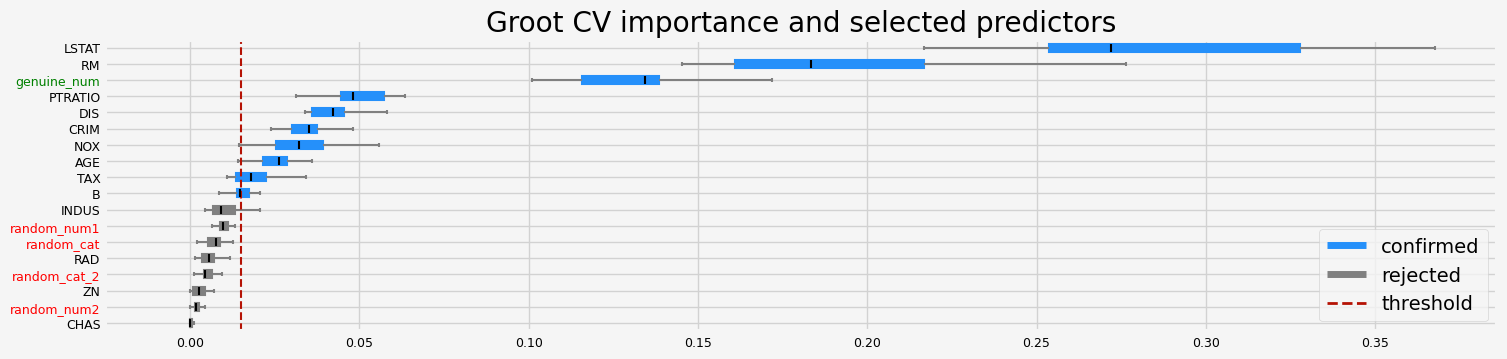
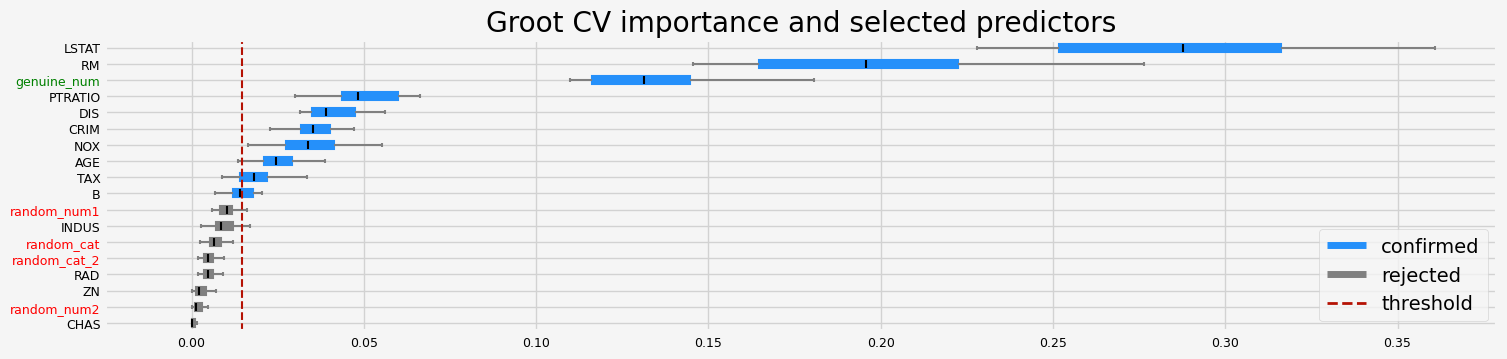
['CRIM' 'NOX' 'RM' 'AGE' 'DIS' 'TAX' 'PTRATIO' 'B' 'LSTAT' 'genuine_num']
[28]:
# Testing the changes with rnd cat. and num. predictors added to the set of genuine predictors
def testing_estimators(X, y, sample_weight=None, objective="rmse"):
    feat_selector = arfsgroot.GrootCV(
        objective=objective, cutoff=1, n_folds=5, n_iter=5, fastshap=False
    )
    feat_selector.fit(X, y, sample_weight)
    print(feat_selector.get_feature_names_out())
    fig = feat_selector.plot_importance(n_feat_per_inch=5)

    # highlight synthetic random variable
    fig = highlight_tick(figure=fig, str_match="random")
    fig = highlight_tick(figure=fig, str_match="genuine", color="green")
    plt.show()
    gc.enable()
    del feat_selector
    gc.collect()


if __name__ == "__main__":
    # regression
    boston = load_data(name="Boston")
    X, y = boston.data, boston.target
    cat_f = boston.categorical
    testing_estimators(X=X, y=y, objective="rmse")
Training until validation scores don't improve for 20 rounds
Early stopping, best iteration is:
[310]   training's l2: 0.147514     valid_1's l2: 10.9022
Training until validation scores don't improve for 20 rounds
Early stopping, best iteration is:
[168]   training's l2: 0.346833     valid_1's l2: 11.4562
Training until validation scores don't improve for 20 rounds
Early stopping, best iteration is:
[69]    training's l2: 1.59845      valid_1's l2: 8.31522
Training until validation scores don't improve for 20 rounds
Early stopping, best iteration is:
[75]    training's l2: 1.42606      valid_1's l2: 7.71274
Training until validation scores don't improve for 20 rounds
Early stopping, best iteration is:
[116]   training's l2: 1.04393      valid_1's l2: 12.044
Training until validation scores don't improve for 20 rounds
Early stopping, best iteration is:
[193]   training's l2: 0.251954     valid_1's l2: 11.0387
Training until validation scores don't improve for 20 rounds
Early stopping, best iteration is:
[100]   training's l2: 1.12263      valid_1's l2: 11.4655
Training until validation scores don't improve for 20 rounds
Early stopping, best iteration is:
[214]   training's l2: 0.1356       valid_1's l2: 12.1415
Training until validation scores don't improve for 20 rounds
Early stopping, best iteration is:
[407]   training's l2: 0.0608068    valid_1's l2: 8.60995
Training until validation scores don't improve for 20 rounds
Early stopping, best iteration is:
[42]    training's l2: 3.22467      valid_1's l2: 8.82285
Training until validation scores don't improve for 20 rounds
Early stopping, best iteration is:
[63]    training's l2: 1.90473      valid_1's l2: 9.90542
Training until validation scores don't improve for 20 rounds
Early stopping, best iteration is:
[170]   training's l2: 0.306401     valid_1's l2: 10.1709
Training until validation scores don't improve for 20 rounds
Early stopping, best iteration is:
[87]    training's l2: 0.73233      valid_1's l2: 18.9126
Training until validation scores don't improve for 20 rounds
Early stopping, best iteration is:
[105]   training's l2: 0.806608     valid_1's l2: 9.91093
Training until validation scores don't improve for 20 rounds
Early stopping, best iteration is:
[72]    training's l2: 1.59131      valid_1's l2: 8.89482
Training until validation scores don't improve for 20 rounds
Early stopping, best iteration is:
[87]    training's l2: 1.38628      valid_1's l2: 12.0891
Training until validation scores don't improve for 20 rounds
Early stopping, best iteration is:
[97]    training's l2: 0.800265     valid_1's l2: 13.5781
Training until validation scores don't improve for 20 rounds
Early stopping, best iteration is:
[46]    training's l2: 2.87756      valid_1's l2: 9.30703
Training until validation scores don't improve for 20 rounds
Early stopping, best iteration is:
[338]   training's l2: 0.0701409    valid_1's l2: 10.0947
Training until validation scores don't improve for 20 rounds
Early stopping, best iteration is:
[88]    training's l2: 0.934871     valid_1's l2: 8.85914
Training until validation scores don't improve for 20 rounds
Early stopping, best iteration is:
[112]   training's l2: 0.806876     valid_1's l2: 9.83223
Training until validation scores don't improve for 20 rounds
Early stopping, best iteration is:
[120]   training's l2: 0.7832       valid_1's l2: 5.92585
Training until validation scores don't improve for 20 rounds
Early stopping, best iteration is:
[324]   training's l2: 0.166045     valid_1's l2: 12.2687
Training until validation scores don't improve for 20 rounds
Early stopping, best iteration is:
[167]   training's l2: 0.284617     valid_1's l2: 10.2344
Training until validation scores don't improve for 20 rounds
Early stopping, best iteration is:
[141]   training's l2: 0.386084     valid_1's l2: 11.265
['CRIM' 'NOX' 'RM' 'AGE' 'DIS' 'TAX' 'PTRATIO' 'B' 'LSTAT' 'genuine_num']
Testing BoostAGroota#
[29]:
models = [
    RandomForestRegressor(n_jobs=4, oob_score=True),
    CatBoostRegressor(random_state=42, verbose=0),
    LGBMRegressor(random_state=42, verbose=-1),
    LightForestRegressor(n_feat=X.shape[1]),
    XGBRegressor(random_state=42, verbosity=0),
]

feat_selector = arfsgroot.BoostAGroota(
    estimator=model, cutoff=1, iters=10, max_rounds=10, delta=0.1
)

if __name__ == "__main__":
    # regression
    boston = load_data(name="Boston")
    X, y = boston.data, boston.target
    cat_f = boston.categorical
    # running the ARFS methods using different models
    compare_varimp(feat_selector, models, X, y, sample_weight=None)
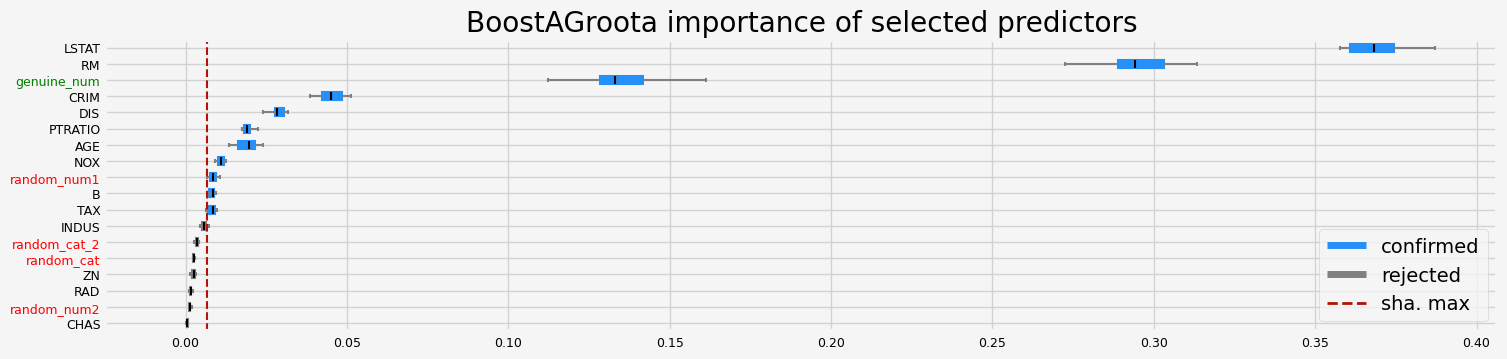
==================== BoostAGroota - testing: RandomForestRegressor for var.imp: shap ====================
['CRIM' 'NOX' 'RM' 'AGE' 'DIS' 'TAX' 'PTRATIO' 'B' 'LSTAT' 'random_num1'
 'genuine_num']
==================== BoostAGroota - testing: RandomForestRegressor for var.imp: pimp ====================
['CRIM' 'NOX' 'RM' 'AGE' 'DIS' 'TAX' 'PTRATIO' 'LSTAT' 'genuine_num']

==================== BoostAGroota - testing: RandomForestRegressor for var.imp: native ====================
['CRIM' 'NOX' 'RM' 'AGE' 'DIS' 'TAX' 'PTRATIO' 'B' 'LSTAT' 'genuine_num']

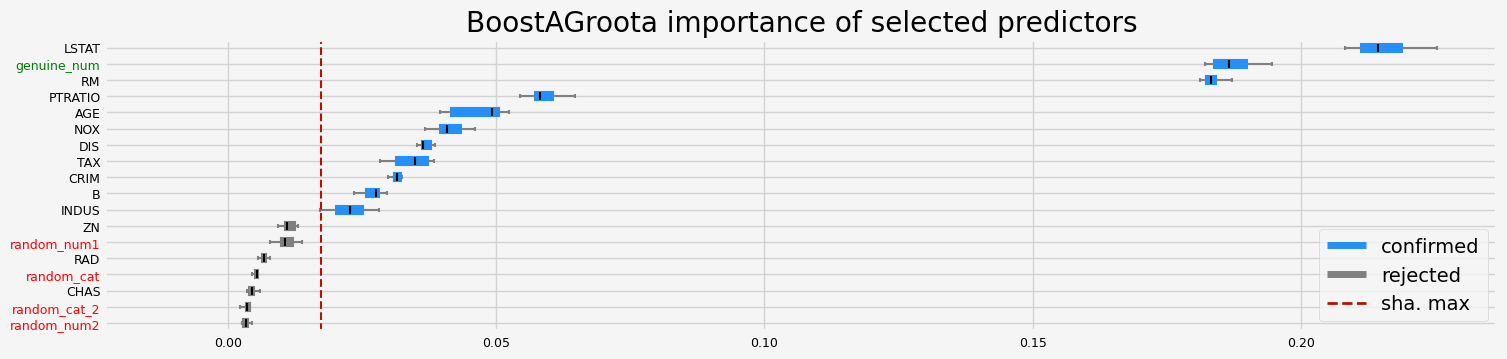
==================== BoostAGroota - testing: CatBoostRegressor for var.imp: shap ====================
['CRIM' 'INDUS' 'NOX' 'RM' 'AGE' 'DIS' 'TAX' 'PTRATIO' 'B' 'LSTAT'
 'genuine_num']
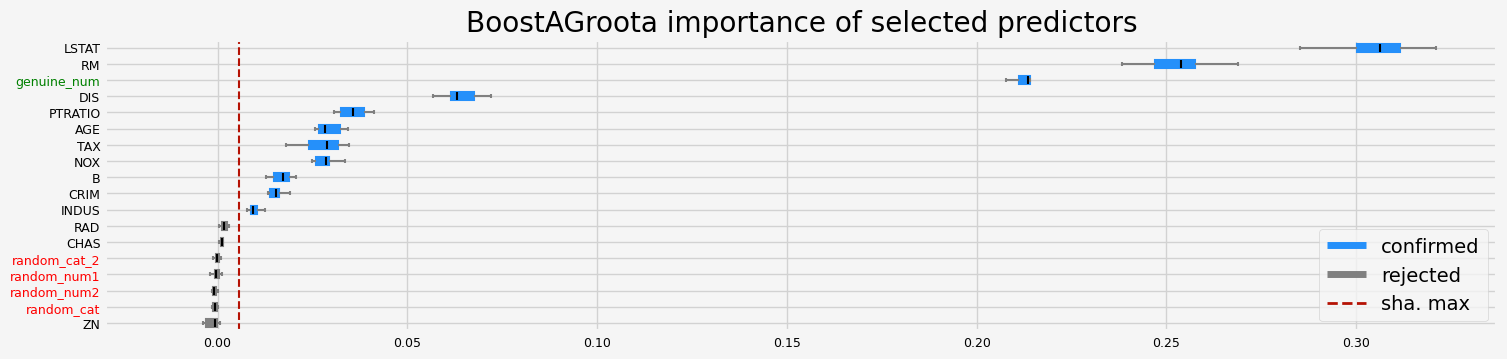
==================== BoostAGroota - testing: CatBoostRegressor for var.imp: pimp ====================
['CRIM' 'INDUS' 'NOX' 'RM' 'AGE' 'DIS' 'TAX' 'PTRATIO' 'B' 'LSTAT'
 'genuine_num']
==================== BoostAGroota - testing: CatBoostRegressor for var.imp: native ====================
['CRIM' 'NOX' 'RM' 'AGE' 'DIS' 'TAX' 'PTRATIO' 'B' 'LSTAT' 'genuine_num']
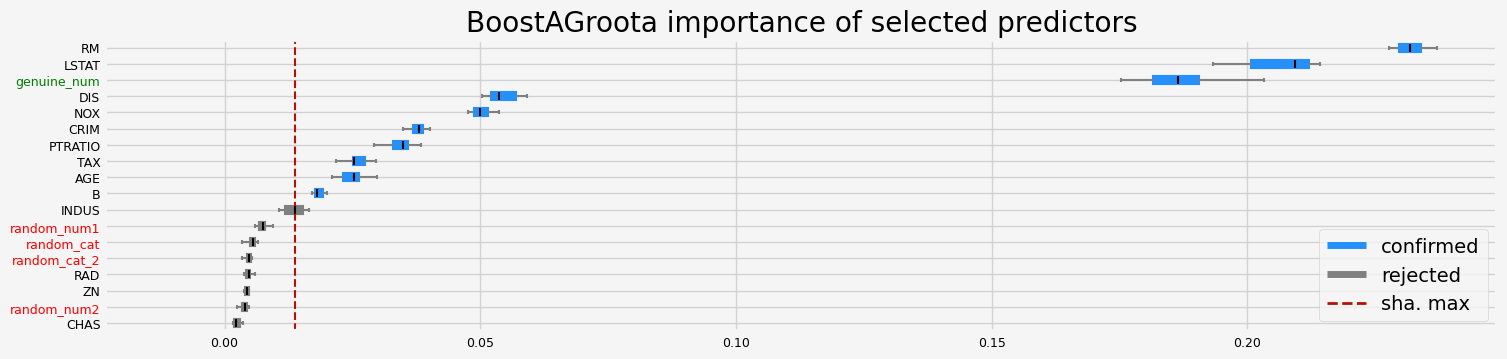
==================== BoostAGroota - testing: LGBMRegressor for var.imp: shap ====================
['CRIM' 'NOX' 'RM' 'AGE' 'DIS' 'PTRATIO' 'LSTAT' 'genuine_num']
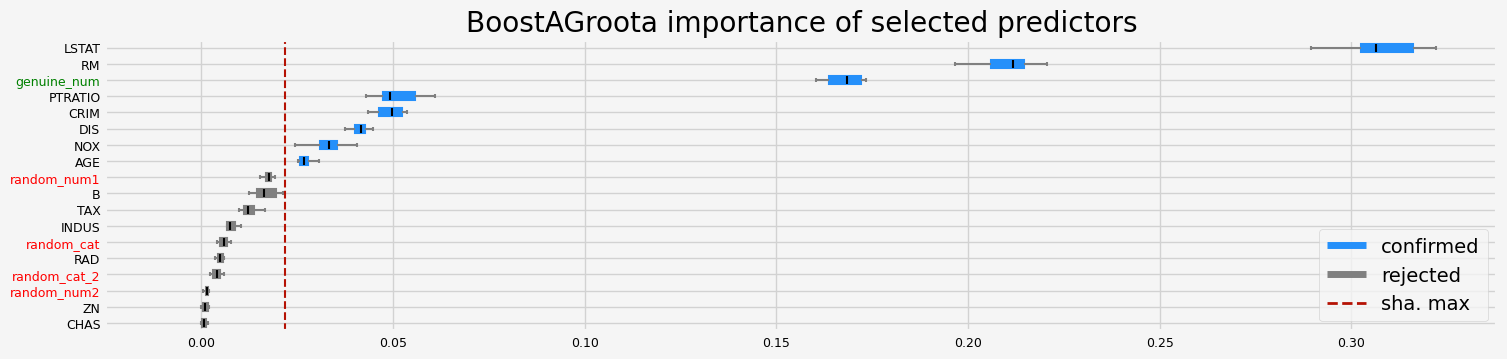
==================== BoostAGroota - testing: LGBMRegressor for var.imp: pimp ====================
['CRIM' 'NOX' 'RM' 'AGE' 'DIS' 'TAX' 'PTRATIO' 'LSTAT' 'genuine_num']

==================== BoostAGroota - testing: LGBMRegressor for var.imp: native ====================
['CRIM' 'NOX' 'RM' 'AGE' 'DIS' 'TAX' 'PTRATIO' 'B' 'LSTAT' 'genuine_num']
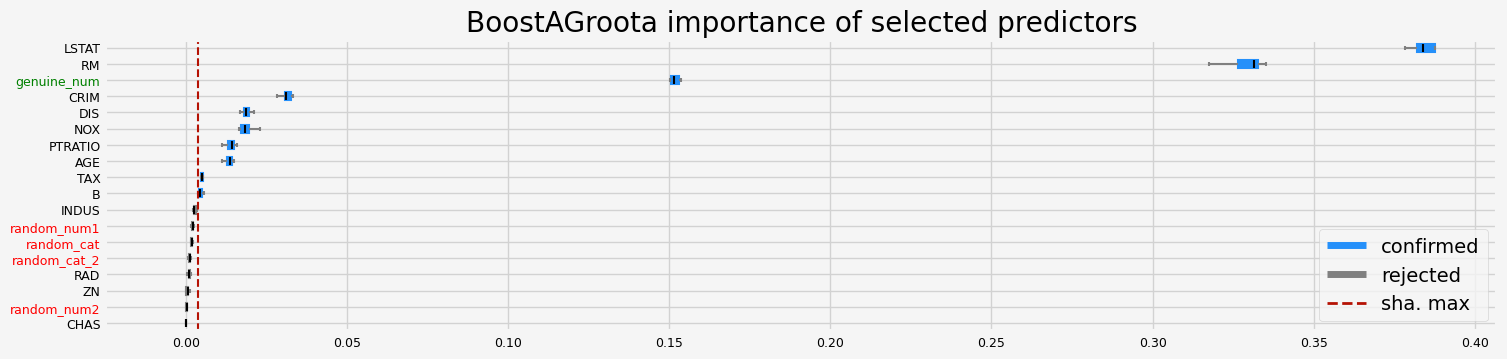
==================== BoostAGroota - testing: LGBMRegressor for var.imp: shap ====================
['CRIM' 'INDUS' 'RM' 'AGE' 'DIS' 'LSTAT' 'genuine_num']
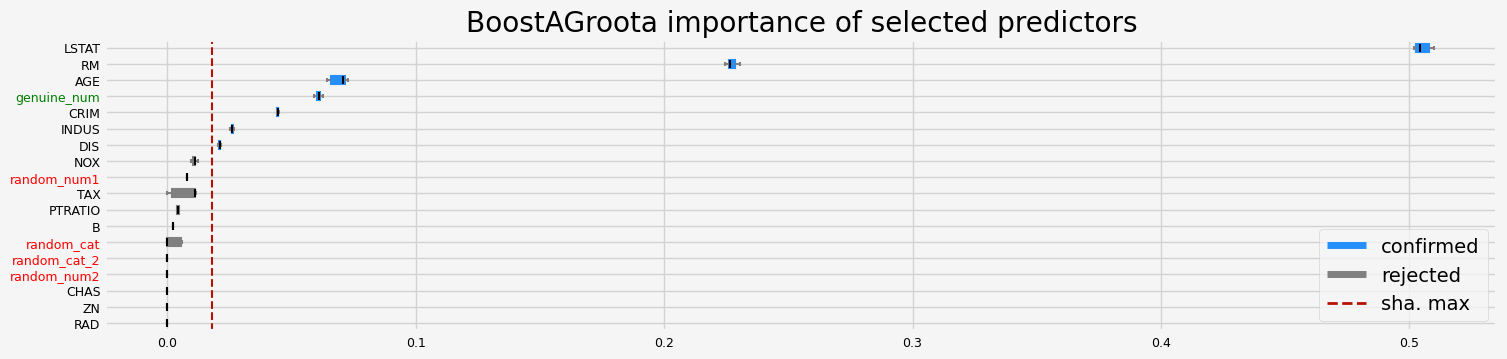
==================== BoostAGroota - testing: LGBMRegressor for var.imp: pimp ====================
['CRIM' 'NOX' 'RM' 'DIS' 'LSTAT' 'genuine_num']
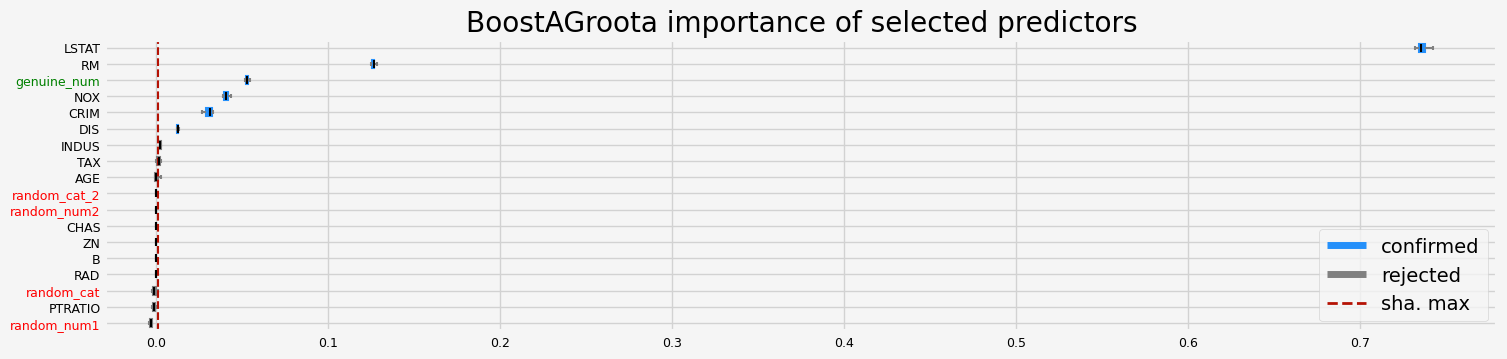
==================== BoostAGroota - testing: LGBMRegressor for var.imp: native ====================
['CRIM' 'NOX' 'RM' 'AGE' 'DIS' 'RAD' 'TAX' 'PTRATIO' 'LSTAT' 'genuine_num']

==================== BoostAGroota - testing: XGBRegressor for var.imp: shap ====================
['CRIM' 'RM' 'AGE' 'DIS' 'PTRATIO' 'B' 'LSTAT' 'genuine_num']
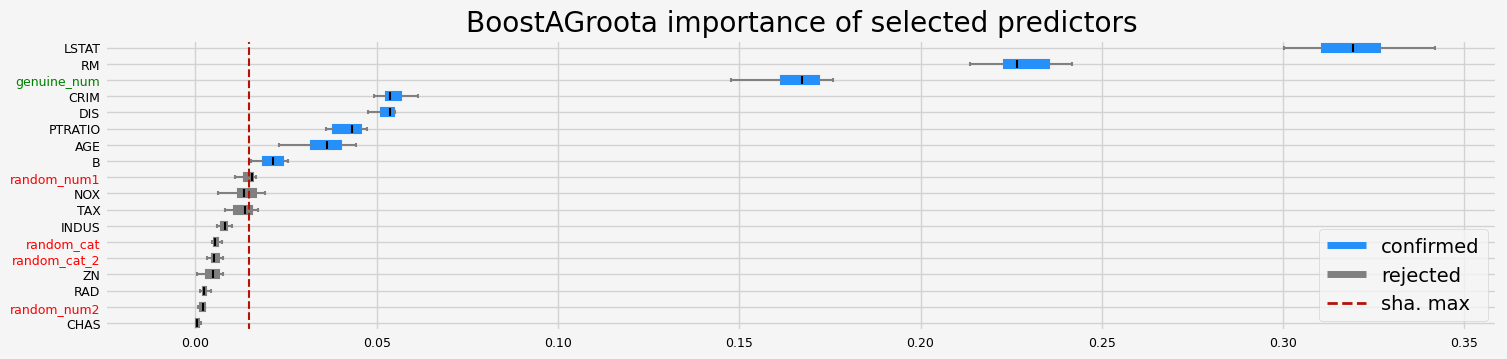
==================== BoostAGroota - testing: XGBRegressor for var.imp: pimp ====================
['CRIM' 'NOX' 'RM' 'AGE' 'DIS' 'PTRATIO' 'LSTAT' 'genuine_num']
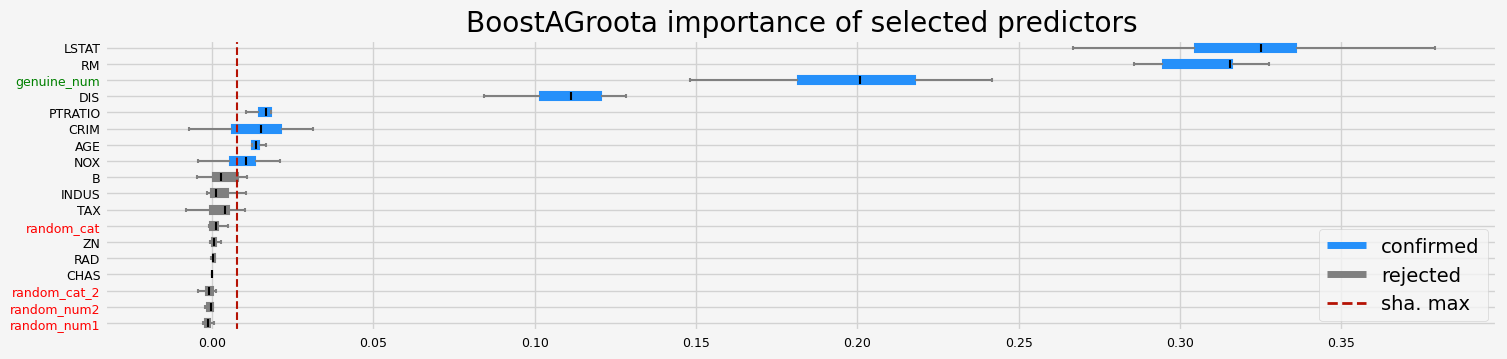
==================== BoostAGroota - testing: XGBRegressor for var.imp: native ====================
['NOX' 'RM' 'DIS' 'TAX' 'PTRATIO' 'LSTAT' 'genuine_num']

[ ]: