
ARFS vs MRmr#
Maximal relevance minimal redundancy feature selection is, theoretically, a subset of all relevant feature selection. However, contrary to the provided ARFS method, there is no criterion for the number of features to select. This is a hyper-parameter, found by HPO or set by the User. On the other hand, ARFS methods are negatively impacted in presence of collinearity while those collinear features are penalized in the MRmr (redundancy part).
[2]:
# from IPython.core.display import display, HTML
# display(HTML("<style>.container { width:95% !important; }</style>"))
import gc
import arfs
import pandas as pd
import numpy as np
import matplotlib.pyplot as plt

from sys import getsizeof, path
from sklearn.pipeline import Pipeline
from arfs.utils import load_data
from arfs.feature_selection import (
    MinRedundancyMaxRelevance,
    GrootCV,
    MissingValueThreshold,
    UniqueValuesThreshold,
    CollinearityThreshold,
    make_fs_summary,
)
from arfs.benchmark import highlight_tick

# plt.style.use('fivethirtyeight')
rng = np.random.RandomState(seed=42)

import warnings

warnings.filterwarnings("ignore")
[3]:
print(f"Run with ARFS {arfs.__version__}")
Run with ARFS 3.0.0
[4]:
gc.enable()
gc.collect()
[4]:
0
MRmr#
convenient, handles collinearity but does not automatically detect the number of features to select (let as a hyper-param).
[5]:
boston = load_data(name="Boston")
X, y = boston.data, boston.target
y.name = "target"
[6]:
y.head()
[6]:
0    24.0
1    21.6
2    34.7
3    33.4
4    36.2
Name: target, dtype: float64
[7]:
X.dtypes
[7]:
CRIM             float64
ZN               float64
INDUS            float64
CHAS            category
NOX              float64
RM               float64
AGE              float64
DIS              float64
RAD             category
TAX              float64
PTRATIO          float64
B                float64
LSTAT            float64
random_num1      float64
random_num2        int32
random_cat      category
random_cat_2    category
genuine_num      float64
dtype: object
[8]:
X.head()
[8]:
| CRIM | ZN | INDUS | CHAS | NOX | RM | AGE | DIS | RAD | TAX | PTRATIO | B | LSTAT | random_num1 | random_num2 | random_cat | random_cat_2 | genuine_num | |
|---|---|---|---|---|---|---|---|---|---|---|---|---|---|---|---|---|---|---|
| 0 | 0.00632 | 18.0 | 2.31 | 0.0 | 0.538 | 6.575 | 65.2 | 4.0900 | 1.0 | 296.0 | 15.3 | 396.90 | 4.98 | 0.496714 | 0 | cat_3517 | Platist | 7.080332 |
| 1 | 0.02731 | 0.0 | 7.07 | 0.0 | 0.469 | 6.421 | 78.9 | 4.9671 | 2.0 | 242.0 | 17.8 | 396.90 | 9.14 | -0.138264 | 0 | cat_2397 | MarkZ | 5.245384 |
| 2 | 0.02729 | 0.0 | 7.07 | 0.0 | 0.469 | 7.185 | 61.1 | 4.9671 | 2.0 | 242.0 | 17.8 | 392.83 | 4.03 | 0.647689 | 0 | cat_3735 | Dracula | 6.375795 |
| 3 | 0.03237 | 0.0 | 2.18 | 0.0 | 0.458 | 6.998 | 45.8 | 6.0622 | 3.0 | 222.0 | 18.7 | 394.63 | 2.94 | 1.523030 | 0 | cat_2870 | Bejita | 6.725118 |
| 4 | 0.06905 | 0.0 | 2.18 | 0.0 | 0.458 | 7.147 | 54.2 | 6.0622 | 3.0 | 222.0 | 18.7 | 396.90 | 5.33 | -0.234153 | 4 | cat_1160 | Variance | 7.867781 |
[9]:
# the number of features is a hyper-param

fs_mrmr = MinRedundancyMaxRelevance(
    n_features_to_select=10,
    relevance_func=None,
    redundancy_func=None,
    task="regression",  # "classification",
    denominator_func=np.mean,
    only_same_domain=False,
    return_scores=False,
    show_progress=True,
    n_jobs=1,
)

# fs_mrmr.fit(X=X, y=y.astype(str), sample_weight=None)
fs_mrmr.fit(X=X, y=y, sample_weight=None)
[9]:
MinRedundancyMaxRelevance(n_features_to_select=10,
                          redundancy_func=functools.partial(<function association_series at 0x71461bb61080>, n_jobs=1, normalize=True),
                          relevance_func=functools.partial(<function f_stat_regression_parallel at 0x71461bb61580>, n_jobs=1))
In a Jupyter environment, please rerun this cell to show the HTML representation or trust the notebook. On GitHub, the HTML representation is unable to render, please try loading this page with nbviewer.org.
MinRedundancyMaxRelevance(n_features_to_select=10,
                          redundancy_func=functools.partial(<function association_series at 0x71461bb61080>, n_jobs=1, normalize=True),
                          relevance_func=functools.partial(<function f_stat_regression_parallel at 0x71461bb61580>, n_jobs=1))
[10]:
X_trans = fs_mrmr.transform(X)
X_trans.head()
[10]:
| LSTAT | genuine_num | CHAS | RAD | RM | INDUS | TAX | NOX | CRIM | PTRATIO | |
|---|---|---|---|---|---|---|---|---|---|---|
| 0 | 4.98 | 7.080332 | 0.0 | 1.0 | 6.575 | 2.31 | 296.0 | 0.538 | 0.00632 | 15.3 |
| 1 | 9.14 | 5.245384 | 0.0 | 2.0 | 6.421 | 7.07 | 242.0 | 0.469 | 0.02731 | 17.8 |
| 2 | 4.03 | 6.375795 | 0.0 | 2.0 | 7.185 | 7.07 | 242.0 | 0.469 | 0.02729 | 17.8 |
| 3 | 2.94 | 6.725118 | 0.0 | 3.0 | 6.998 | 2.18 | 222.0 | 0.458 | 0.03237 | 18.7 |
| 4 | 5.33 | 7.867781 | 0.0 | 3.0 | 7.147 | 2.18 | 222.0 | 0.458 | 0.06905 | 18.7 |
[11]:
fs_mrmr.feature_names_in_
[11]:
array(['CRIM', 'ZN', 'INDUS', 'CHAS', 'NOX', 'RM', 'AGE', 'DIS', 'RAD',
       'TAX', 'PTRATIO', 'B', 'LSTAT', 'random_num1', 'random_num2',
       'random_cat', 'random_cat_2', 'genuine_num'], dtype=object)
[12]:
fs_mrmr.support_
[12]:
array([ True, False,  True,  True,  True,  True, False, False,  True,
        True,  True, False,  True, False, False, False, False,  True])
[13]:
fs_mrmr.get_feature_names_out()
[13]:
array(['CRIM', 'INDUS', 'CHAS', 'NOX', 'RM', 'RAD', 'TAX', 'PTRATIO',
       'LSTAT', 'genuine_num'], dtype=object)
[14]:
fs_mrmr.ranking_
[14]:
| mrmr | relevance | redundancy | |
|---|---|---|---|
| LSTAT | inf | 3.026693 | 0.000000 |
| genuine_num | 1131.029947 | 1.131030 | 0.001000 |
| CHAS | 1.787263 | 0.731266 | 0.409154 |
| RAD | 2.262116 | 0.990593 | 0.437905 |
| RM | 0.571875 | 0.145600 | 0.254601 |
| INDUS | -0.324591 | -0.096957 | 0.298705 |
| TAX | -0.358787 | -0.154209 | 0.429805 |
| NOX | -0.328722 | -0.153521 | 0.467023 |
| CRIM | -0.324877 | -0.166310 | 0.511916 |
| PTRATIO | -0.381959 | -0.176410 | 0.461857 |
ARFS - GrootCV#
Cross-validated, using a stopping criterion for the features to select, does not play well with high collinearity.
[15]:
boston = load_data(name="Boston")
X, y = boston.data, boston.target
y.name = "target"
[16]:
%%time
# GrootCV
feat_selector = GrootCV(objective="rmse", cutoff=1, n_folds=5, n_iter=5, silent=True)
feat_selector.fit(X, y, sample_weight=None)
print(f"The selected features: {feat_selector.get_feature_names_out()}")
print(f"The agnostic ranking: {feat_selector.ranking_}")
print(f"The naive ranking: {feat_selector.ranking_absolutes_}")
fig = feat_selector.plot_importance(n_feat_per_inch=5)

# highlight synthetic random variable
fig = highlight_tick(figure=fig, str_match="random")
fig = highlight_tick(figure=fig, str_match="genuine", color="green")
plt.show()
Training until validation scores don't improve for 20 rounds
Early stopping, best iteration is:
[238]   training's l2: 0.224881     valid_1's l2: 12.6928
Training until validation scores don't improve for 20 rounds
Early stopping, best iteration is:
[412]   training's l2: 0.0381449    valid_1's l2: 10.5172
Training until validation scores don't improve for 20 rounds
Early stopping, best iteration is:
[52]    training's l2: 2.45293      valid_1's l2: 8.55685
Training until validation scores don't improve for 20 rounds
Early stopping, best iteration is:
[55]    training's l2: 2.03526      valid_1's l2: 8.125
Training until validation scores don't improve for 20 rounds
Early stopping, best iteration is:
[52]    training's l2: 2.9843       valid_1's l2: 13.4019
Training until validation scores don't improve for 20 rounds
Early stopping, best iteration is:
[78]    training's l2: 1.35125      valid_1's l2: 12.4942
Training until validation scores don't improve for 20 rounds
Early stopping, best iteration is:
[234]   training's l2: 0.144527     valid_1's l2: 10.9799
Training until validation scores don't improve for 20 rounds
Early stopping, best iteration is:
[227]   training's l2: 0.114625     valid_1's l2: 11.3945
Training until validation scores don't improve for 20 rounds
Early stopping, best iteration is:
[110]   training's l2: 0.700409     valid_1's l2: 9.77917
Training until validation scores don't improve for 20 rounds
Early stopping, best iteration is:
[229]   training's l2: 0.111861     valid_1's l2: 7.52847
Training until validation scores don't improve for 20 rounds
Early stopping, best iteration is:
[44]    training's l2: 3.13271      valid_1's l2: 10.5874
Training until validation scores don't improve for 20 rounds
Early stopping, best iteration is:
[328]   training's l2: 0.0248466    valid_1's l2: 10.3883
Training until validation scores don't improve for 20 rounds
Early stopping, best iteration is:
[110]   training's l2: 0.453739     valid_1's l2: 17.2555
Training until validation scores don't improve for 20 rounds
Early stopping, best iteration is:
[79]    training's l2: 1.25168      valid_1's l2: 9.59104
Training until validation scores don't improve for 20 rounds
Early stopping, best iteration is:
[177]   training's l2: 0.27132      valid_1's l2: 7.54623
Training until validation scores don't improve for 20 rounds
Early stopping, best iteration is:
[486]   training's l2: 0.0222516    valid_1's l2: 11.9391
Training until validation scores don't improve for 20 rounds
Early stopping, best iteration is:
[145]   training's l2: 0.418426     valid_1's l2: 13.6506
Training until validation scores don't improve for 20 rounds
Early stopping, best iteration is:
[38]    training's l2: 3.56361      valid_1's l2: 9.26995
Training until validation scores don't improve for 20 rounds
Early stopping, best iteration is:
[243]   training's l2: 0.234916     valid_1's l2: 8.68421
Training until validation scores don't improve for 20 rounds
Early stopping, best iteration is:
[39]    training's l2: 3.51271      valid_1's l2: 9.71386
Training until validation scores don't improve for 20 rounds
Early stopping, best iteration is:
[133]   training's l2: 0.585123     valid_1's l2: 9.29017
Training until validation scores don't improve for 20 rounds
Early stopping, best iteration is:
[151]   training's l2: 0.396861     valid_1's l2: 6.23042
Training until validation scores don't improve for 20 rounds
Early stopping, best iteration is:
[487]   training's l2: 0.0443864    valid_1's l2: 10.1834
Training until validation scores don't improve for 20 rounds
Early stopping, best iteration is:
[101]   training's l2: 0.882552     valid_1's l2: 10.2793
Training until validation scores don't improve for 20 rounds
Early stopping, best iteration is:
[142]   training's l2: 0.378955     valid_1's l2: 11.171
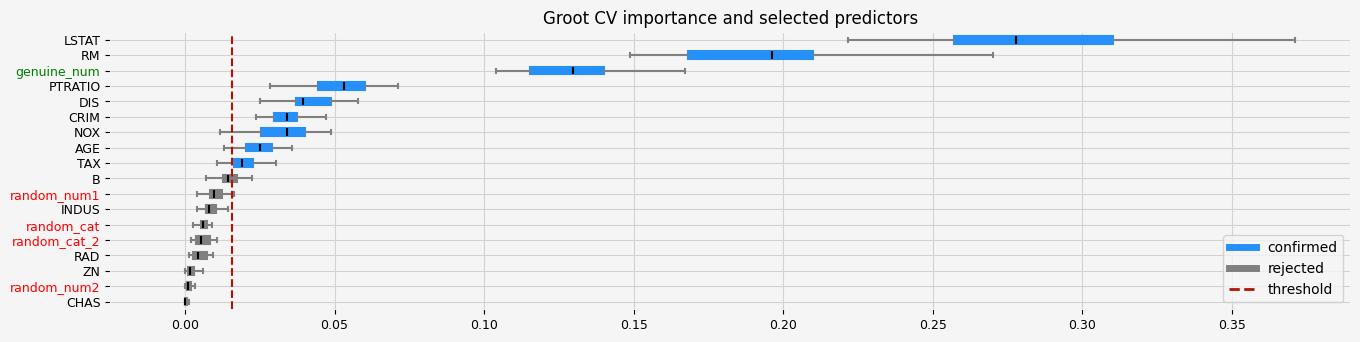
The selected features: ['CRIM' 'NOX' 'RM' 'AGE' 'DIS' 'TAX' 'PTRATIO' 'LSTAT' 'genuine_num']
The agnostic ranking: [2 1 1 1 2 2 2 2 1 2 2 1 2 1 1 1 1 2]
The naive ranking: ['LSTAT', 'RM', 'PTRATIO', 'DIS', 'CRIM', 'NOX', 'AGE', 'B', 'ShadowVar1', 'ShadowVar13', 'INDUS', 'ShadowVar14', 'ShadowVar12', 'ShadowVar10', 'ShadowVar11', 'RAD', 'ShadowVar15', 'CHAS']
CPU times: user 49.3 s, sys: 837 ms, total: 50.2 s
Wall time: 18.6 s
Using a pipeline for filtering out collinear features and improving the stability of the selection
[17]:
feat_selector = GrootCV(objective="rmse", cutoff=1, n_folds=5, n_iter=5, silent=True)

arfs_fs_pipeline = Pipeline(
    [
        ("missing", MissingValueThreshold(threshold=0.05)),
        ("unique", UniqueValuesThreshold(threshold=1)),
        ("collinearity", CollinearityThreshold(threshold=0.85)),
        ("arfs", feat_selector),
    ]
)

X_trans = arfs_fs_pipeline.fit(X=X, y=y).transform(X=X)
Training until validation scores don't improve for 20 rounds
Early stopping, best iteration is:
[309]   training's l2: 0.110849     valid_1's l2: 11.3895
Training until validation scores don't improve for 20 rounds
Early stopping, best iteration is:
[454]   training's l2: 0.0350823    valid_1's l2: 11.5974
Training until validation scores don't improve for 20 rounds
Early stopping, best iteration is:
[63]    training's l2: 1.88814      valid_1's l2: 9.15364
Training until validation scores don't improve for 20 rounds
Early stopping, best iteration is:
[65]    training's l2: 1.66584      valid_1's l2: 8.87393
Training until validation scores don't improve for 20 rounds
Early stopping, best iteration is:
[41]    training's l2: 4.04353      valid_1's l2: 12.4968
Training until validation scores don't improve for 20 rounds
Early stopping, best iteration is:
[124]   training's l2: 0.69636      valid_1's l2: 11.9757
Training until validation scores don't improve for 20 rounds
Early stopping, best iteration is:
[99]    training's l2: 1.13678      valid_1's l2: 11.5807
Training until validation scores don't improve for 20 rounds
Early stopping, best iteration is:
[43]    training's l2: 3.83392      valid_1's l2: 13.7868
Training until validation scores don't improve for 20 rounds
Early stopping, best iteration is:
[47]    training's l2: 2.57147      valid_1's l2: 11.3632
Training until validation scores don't improve for 20 rounds
Early stopping, best iteration is:
[98]    training's l2: 0.949745     valid_1's l2: 8.76278
Training until validation scores don't improve for 20 rounds
Early stopping, best iteration is:
[51]    training's l2: 2.4229       valid_1's l2: 10.4737
Training until validation scores don't improve for 20 rounds
Early stopping, best iteration is:
[124]   training's l2: 0.818129     valid_1's l2: 10.3024
Training until validation scores don't improve for 20 rounds
Early stopping, best iteration is:
[146]   training's l2: 0.210475     valid_1's l2: 18.5984
Training until validation scores don't improve for 20 rounds
Early stopping, best iteration is:
[75]    training's l2: 1.55874      valid_1's l2: 10.0471
Training until validation scores don't improve for 20 rounds
Early stopping, best iteration is:
[51]    training's l2: 2.94458      valid_1's l2: 9.30534
Training until validation scores don't improve for 20 rounds
Early stopping, best iteration is:
[355]   training's l2: 0.0706042    valid_1's l2: 13.3301
Training until validation scores don't improve for 20 rounds
Early stopping, best iteration is:
[53]    training's l2: 2.19216      valid_1's l2: 16.0044
Training until validation scores don't improve for 20 rounds
Early stopping, best iteration is:
[45]    training's l2: 3.06666      valid_1's l2: 9.26714
Training until validation scores don't improve for 20 rounds
Early stopping, best iteration is:
[239]   training's l2: 0.204769     valid_1's l2: 7.96954
Training until validation scores don't improve for 20 rounds
Early stopping, best iteration is:
[108]   training's l2: 0.733229     valid_1's l2: 9.26194
Training until validation scores don't improve for 20 rounds
Early stopping, best iteration is:
[92]    training's l2: 1.35678      valid_1's l2: 10.267
Training until validation scores don't improve for 20 rounds
Early stopping, best iteration is:
[101]   training's l2: 1.03857      valid_1's l2: 6.50716
Training until validation scores don't improve for 20 rounds
Early stopping, best iteration is:
[42]    training's l2: 3.35878      valid_1's l2: 14.9922
Training until validation scores don't improve for 20 rounds
Early stopping, best iteration is:
[56]    training's l2: 2.53815      valid_1's l2: 11.2274
Training until validation scores don't improve for 20 rounds
Early stopping, best iteration is:
[181]   training's l2: 0.213888     valid_1's l2: 10.3592
[18]:
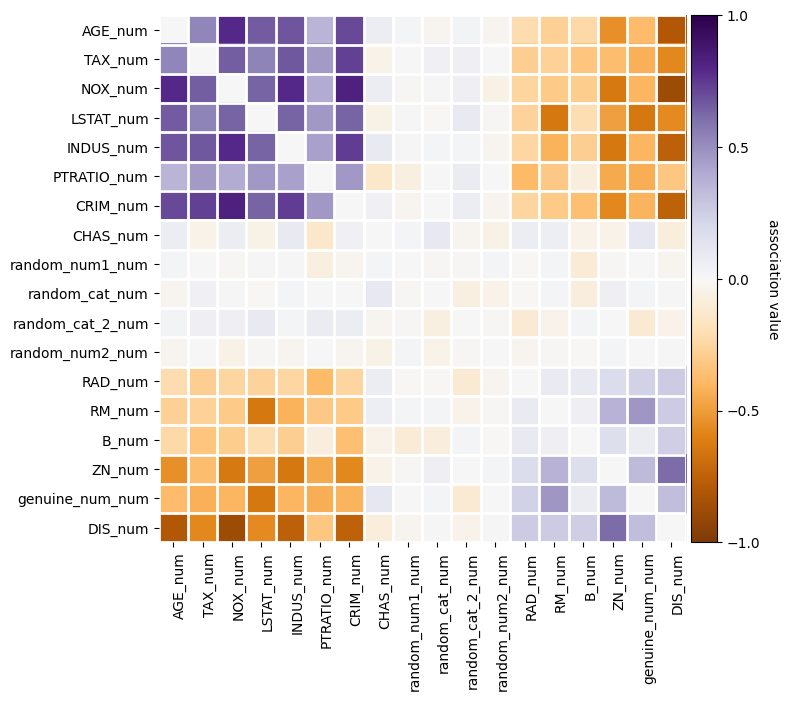
arfs_fs_pipeline.named_steps["collinearity"].get_feature_names_out()
[18]:
array(['CRIM', 'ZN', 'INDUS', 'CHAS', 'RM', 'AGE', 'DIS', 'RAD', 'TAX',
       'PTRATIO', 'B', 'LSTAT', 'random_num1', 'random_num2',
       'random_cat', 'random_cat_2', 'genuine_num'], dtype=object)
[19]:
f = arfs_fs_pipeline.named_steps["collinearity"].plot_association(figsize=(8, 8))
[20]:
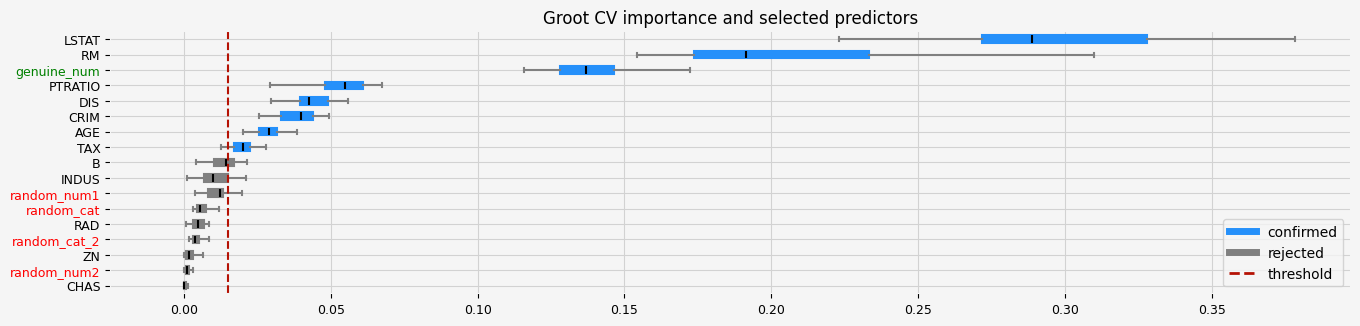
fig = arfs_fs_pipeline.named_steps["arfs"].plot_importance()
# highlight synthetic random variable
fig = highlight_tick(figure=fig, str_match="random")
fig = highlight_tick(figure=fig, str_match="genuine", color="green")
plt.show()
[21]:
make_fs_summary(arfs_fs_pipeline)
[21]:
| predictor | missing | unique | collinearity | arfs | |
|---|---|---|---|---|---|
| 0 | CRIM | 1 | 1 | 1 | 1 |
| 1 | ZN | 1 | 1 | 1 | 0 |
| 2 | INDUS | 1 | 1 | 1 | 0 |
| 3 | CHAS | 1 | 1 | 1 | 0 |
| 4 | NOX | 1 | 1 | 0 | nan |
| 5 | RM | 1 | 1 | 1 | 1 |
| 6 | AGE | 1 | 1 | 1 | 1 |
| 7 | DIS | 1 | 1 | 1 | 1 |
| 8 | RAD | 1 | 1 | 1 | 0 |
| 9 | TAX | 1 | 1 | 1 | 1 |
| 10 | PTRATIO | 1 | 1 | 1 | 1 |
| 11 | B | 1 | 1 | 1 | 0 |
| 12 | LSTAT | 1 | 1 | 1 | 1 |
| 13 | random_num1 | 1 | 1 | 1 | 0 |
| 14 | random_num2 | 1 | 1 | 1 | 0 |
| 15 | random_cat | 1 | 1 | 1 | 0 |
| 16 | random_cat_2 | 1 | 1 | 1 | 0 |
| 17 | genuine_num | 1 | 1 | 1 | 1 |